
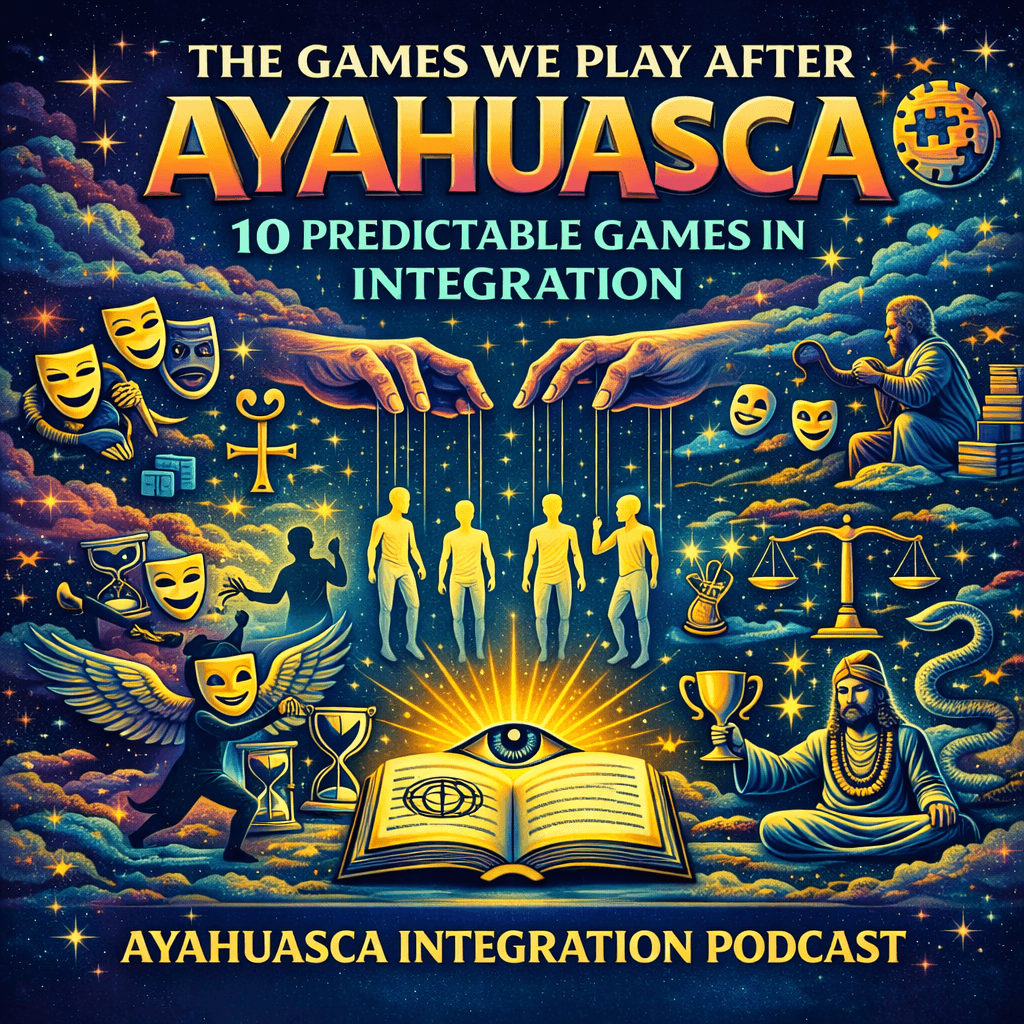
Did you know that we all play games in healing and transformative work?
And the ones who say they don’t are often playing some of the most dangerous games that exist in the spiritual realm, with themselves and with others.

You’ve probably seen it.
How healing turns into performance.
How people suddenly become gurus on social media, wearing outfits they never wear in their real lives.
How you get triggered by someone in a ceremony space without knowing why.
These are integration games.
There are ten predictable games that show up during and after ceremony. Chances are you’re playing some of them right now in your own life. Awareness doesn’t fix anything by itself, but it creates choice. That’s the point of this article.
In the early days of psychedelic research, especially in the 1960s when LSD was being studied in therapeutic and exploratory settings, researchers started noticing something important. Not just what people experienced, but how they behaved inside those states.
One of the earliest attempts to name this was a short manual published in 1967 called Session Games People Play: A Manual for the Use of LSD, written by Lisa Bieberman. It was created to help people recognize the predictable behavioral patterns that tend to appear when intensity rises and ordinary reference points fall away.
What they observed was simple and striking.
The content of psychedelic experiences varies enormously. Visions, memories, emotions, and insights are highly individual. But the behavioral patterns are not.
People tend to respond in familiar ways.
They avoid.
They perform.
They take control.
They withdraw.
They distract themselves.
They project.
The same moves appeared again and again, across different people and different sessions.
I’ve seen the same thing.
After more than ten years working with ceremony, integration, and facilitation, the medicine changes, the setting changes, the language changes, but the games stay remarkably consistent.
Over time, I began introducing this idea to clients, but only after trust was established. Not to correct anyone. Not to diagnose. Not to sit above the work. The purpose was to give people a way to recognize themselves without collapsing into shame or blame.
When someone can say, “Ah, this is one of my games,” something loosens. There’s more space. Less identification. More choice.
They don’t need to stop the pattern. They just don’t have to be completely inside it.
One thing needs to be said clearly.
There is no point where the games disappear.
You can study enlightenment teachings. You can meditate for decades. You can sit alone on a mountaintop. Parts of you will still be playing games, even with yourself, even with silence, even with nature.
There is no way out of the game. There never was. The idea that you can exit it entirely is another game we play once we become spiritual.
What is possible is becoming conscious of how the game is being played.
That’s what this article is for.
I’m going to walk through the ten most common games I see in psychedelic integration, and for each one, I’ll speak to practical integration tools that help people relate to these patterns differently, so the work doesn’t just feel deep, but actually starts to change how life is lived.

10 Common Ayahuasca Integration Games:
Download free field-guide here:
1. Projection & Avoidance Games
Get Me Out of This
Surface Behavior: Individuals feel fear, anxiety, or discomfort early in the experience and attempt to leave or withdraw physically, emotionally, or mentally. They may vocalize a desire to quit, fidget excessively, or detach from group activities.
Core Motivation: This game is driven by a deep need for safety and control. Facing intense emotions, confronting suppressed memories, or encountering unfamiliar internal landscapes triggers survival-based fear. The mind interprets leaving as the fastest way to regain a sense of security, but it bypasses the very process that can lead to transformation.
Impact on Group / Self: For the individual, this game prevents meaningful engagement and interrupts the integration of challenging experiences. It may lead to avoidance patterns extending beyond the ceremony, reinforcing a habit of fleeing discomfort in life. For the group, it can destabilize energy containment. Other participants may be distracted, concerned, or have their own emotional work triggered by witnessing the withdrawal.
Integration Tip: Encourage grounding practices: conscious breathing, gentle reminder of temporary discomfort, and the understanding that emotions are sensations to move through rather than obstacles to escape. Facilitation should honor the discomfort while maintaining the frame — reassurance without rescue. Journaling post-session can help the participant recognize patterns of avoidance in daily life.
Let’s Call It a Day
Surface Behavior: The person attempts to end the ceremony or integration session prematurely, often citing fatigue, discomfort, or impatience. They may become restless, check the time repeatedly, or disengage physically.
Core Motivation: Fear of intensity and a desire to maintain control drive this game. The participant seeks to impose their own timeline on a process that has its own organic rhythm, often because sitting with uncertainty or surrender feels unsafe.
Impact on Group / Self: Early termination truncates potential insight, undermines closure, and interrupts the energy flow of the ceremony. Others may feel anxiety or frustration, which can ripple through the circle, reducing collective depth.
Integration Tip: Reinforce trust in the process. Encourage the participant to observe their impulses to “quit” and explore what fear or shame underlies it. Practical techniques include body awareness, breath work, and micro-moments of surrender — staying present for small increments builds tolerance to the full arc of experience.
I Don’t Feel / Numb Game
Surface Behavior: The individual appears disengaged, flat, or emotionally muted. They may report “I don’t feel anything” or act overly controlled, avoiding expressions of vulnerability.
Core Motivation: Avoidance of painful emotions or unresolved trauma drives this game. Emotional numbing provides temporary relief from discomfort but prevents authentic processing and healing. Shame and fear are often at the root: feeling unsafe to allow vulnerability or fearing judgment.
Impact on Group / Self: Blocks personal insight and prevents the participant from connecting with their own emotional intelligence. For the group, it can create an energetic dead zone, reducing resonance and vulnerability. Other members may unconsciously compensate or feel frustrated by the lack of engagement.
Integration Tip: Facilitate somatic awareness: encourage noticing bodily sensations, breath, and small emotional ripples without forcing expression. Journaling, art, or guided movement post-session can help translate numbness into insight. Emphasize that “feeling nothing” is itself a signal to observe rather than judge.
This One Doesn’t Count
Surface Behavior: Treating the ceremony or session as trivial, playful, or experimental. The individual may joke excessively, take photos, or focus on external curiosities rather than the inner journey.
Core Motivation: Fear of vulnerability and the unknown drives this game. By trivializing the process, the participant shields themselves from deep emotional confrontation. It’s often a defense against shame: “If I don’t take this seriously, I can’t fail or be judged.”
Impact on Group / Self: Reduces the depth of engagement, leading to superficial insight. Others may feel irritation, or the group’s energy may fragment. For the individual, the pattern can generalize to avoidance of serious work in life.
Integration Tip: Encourage presence by anchoring attention in small, tangible practices: breath, movement, or ritual steps. Validate curiosity but maintain structure. Reflection exercises post-session can highlight insights that were missed due to trivialization.
Overload / Busy Brain Game
Surface Behavior: Continuously seeking new teachings, books, practices, or modalities. The individual may juggle multiple frameworks simultaneously, over-schedule sessions, or constantly ask questions without fully processing prior experiences.
Core Motivation: Avoidance of internal processing and discomfort. Shame or fear of inadequacy drives the compulsion to accumulate knowledge as a proxy for transformation. The mind stays “busy” to prevent stillness and reflection, which would bring unresolved material to awareness.
Impact on Group / Self: Prevents integration; insights are rarely embodied. The group may be unaffected directly but witnessing the overwhelm can trigger comparison or pressure among participants. Long-term, this pattern manifests as scattered energy and stalled personal growth.
Integration Tip: Encourage focused engagement: limit practices, allow time for reflection, and emphasize embodiment over accumulation. Journaling, somatic exercises, or meditation on one insight at a time can help break the overload loop.
Blame Game
Surface Behavior: The individual consistently attributes responsibility for discomfort, confusion, or setbacks to others — facilitators, peers, or even the medicine itself. They may vocalize complaints, point fingers, or rationalize their struggles as caused externally.
Core Motivation: Rooted in avoidance of accountability and underlying shame, the blame game protects the ego from confronting personal responsibility. By externalizing problems, the participant maintains a sense of control and avoids the discomfort of self-examination. Fear of failure or inadequacy reinforces this mechanism.
Impact on Group / Self: For the individual, blaming others stalls personal growth, inhibits integration, and reinforces cycles of powerlessness. Within the group, blame generates tension, defensiveness, and subtle conflict. It disrupts trust, diminishes relational safety, and can trigger resentment or withdrawal among peers.
Integration Tip: Encourage introspection and ownership of experience. Journaling prompts like “What is mine here?” or reflective dialogue can shift perspective inward. Somatic awareness and mindful noticing of emotional triggers help reclaim agency. Facilitators can model accountability while holding compassionate boundaries, reinforcing personal responsibility without shaming.
Victim Game
Surface Behavior: Positions self as powerless or oppressed, often emphasizing helplessness in relation to facilitators, peers, or life circumstances. They may over-express suffering, dramatize setbacks, or seek sympathy.
Core Motivation: Driven by shame, fear, and avoidance, this game provides temporary relief from internal conflict by externalizing pain. The ego gains validation through others’ attention or compassion, masking discomfort with emotional authority. Patterns often emerge from early trauma or learned helplessness.
Impact on Group / Self: Reinforces powerlessness and dependency for the individual. Blocks internal processing, shadow work, and empowerment. Within the group, it creates emotional strain, as others may feel compelled to “rescue” or may experience frustration. Repeated victimization undermines collective cohesion and slows integration.
Integration Tip: Foster recognition of personal agency. Practices like somatic tracking, journaling, and guided reflection help identify when pain is being weaponized versus processed. Encourage reclaiming energy and empowerment while maintaining empathy for personal suffering. Mentorship and structured reflection can strengthen capacity for self-sovereignty.
Savior Game
Surface Behavior: Attributes all insights, guidance, or solutions to the medicine or external forces. They may insist that understanding or wisdom is “given” rather than personally accessed, deflecting ownership.
Core Motivation: Rooted in avoidance and fear of personal responsibility, this game externalizes authority. By crediting external forces, the participant reduces internal pressure and temporarily absolves themselves from accountability or integration work. Shame around perceived inadequacy often drives this behavior.
Impact on Group / Self: Weakens internal authority and integration. The individual may remain passive, expecting external validation or direction for action. For the group, it fosters reliance on authority rather than personal insight, subtly undermining collective empowerment and self-trust.
Integration Tip: Encourage reflection on personal agency and the distinction between catalyst and ownership. Journaling, somatic exercises, and deliberate reflection on decisions and insights reclaim responsibility. Facilitators can emphasize that while the medicine provides guidance, true integration requires active, personal engagement.
Martyr Game
Surface Behavior: Highlights personal suffering, sacrifice, or endurance to gain moral recognition, sympathy, or admiration. May dramatize pain or frame experience as uniquely challenging.
Core Motivation: Driven by shame, fear, and desire for validation, this game masks insecurity with apparent virtue. By emphasizing suffering, the ego secures acknowledgment while avoiding engagement with underlying vulnerability or emotional processing.
Impact on Group / Self: Diverts energy away from authentic reflection and integration. Others may feel guilt, pressure, or fatigue from compensating for the “martyr,” fracturing collective cohesion. For the individual, martyrdom reinforces attachment to suffering and inhibits empowerment or balanced self-care.
Integration Tip: Encourage self-compassion and balanced acknowledgment of difficulty without dramatization. Journaling, somatic tracking, and reflective exercises help distinguish authentic struggle from performative martyrdom. Facilitators can model validation without reinforcing dramatization, promoting empowered presence over victim-based
2. Attention / Validation Games
Show-Off Game
Surface Behavior: The participant performs insights, visions, or revelations in an exaggerated or theatrical way. They may vocalize loudly, act dramatically, or display artistic expressions with the clear intention of impressing others. This often occurs mid-ceremony or during sharing circles.
Core Motivation: At its core, this game is driven by shame and the need for external validation. The individual may feel internally inadequate, powerless, or invisible, and so seeks recognition through performance. The show-off behavior is a defense: instead of confronting inner discomfort or vulnerability, the participant projects confidence or expertise outwardly, hoping to secure acknowledgment from peers. This often masks insecurity and fear of being overlooked or judged as “not enough.”
Impact on Group / Self: For the individual, performing can temporarily soothe feelings of shame, but it prevents authentic connection with their own process. Deep insight is often sacrificed for theatricality, and learning remains superficial. Within the group, this behavior can be distracting, drawing attention away from collective presence and energy. Other participants may unconsciously compete, feel diminished, or become resentful. Over time, repeated show-off patterns can reinforce dependency on external validation and stunt personal integration.
Integration Tip: Encourage the participant to notice when performance is arising as a protective strategy rather than authentic expression. Practices like grounding breathwork, embodied awareness, or private journaling can help distinguish genuine insight from performative display. Facilitators can model restraint and subtle acknowledgment: honor authentic contributions without amplifying performative behaviors. Reflection post-session can reveal underlying insecurities and patterns, allowing the participant to reclaim intrinsic worth independent of audience response.
Over-Sharer
Surface Behavior: Shares personal stories, intimate feelings, or traumas excessively and without attunement to the group’s capacity. They dominate sharing circles, often focusing on details irrelevant to collective integration.
Core Motivation: Driven by shame, fear of invisibility, or unresolved longing for connection, the over-sharer seeks acknowledgment, empathy, or affirmation. By laying bare every detail, they attempt to control perception and influence the group’s response, hoping to feel seen or significant. Often, the individual cannot tolerate silence, uncertainty, or holding material privately, because vulnerability triggers anxiety and the need for immediate validation.
Impact on Group / Self: Over-sharing can overwhelm others, destabilize the group’s emotional field, and create fatigue or irritation. For the individual, it prevents integration: raw material is dumped rather than processed internally or through reflective work. Emotional regulation is bypassed, so insights remain superficial. Patterns of over-sharing often generalize into daily life, where relational boundaries and personal privacy are compromised.
Integration Tip: Encourage the participant to practice containment and attunement. Techniques include journaling privately before sharing, structured timing for speaking, and mindfulness to notice impulses to over-share. Facilitators can guide them to distill essence without losing depth, cultivating discernment between what is essential to share and what can be processed internally.
Attention Seeker
Surface Behavior: Uses drama, exaggeration, humor, or conflict to draw focus. May exaggerate reactions, interrupt others, or stage moments to be noticed. Often, the attention-seeking emerges when the individual feels invisible, dismissed, or overshadowed in the group.
Core Motivation: Deep shame and fear of abandonment fuel this game. The individual fears being overlooked or irrelevant, so they manufacture situations that guarantee notice. This often disguises vulnerability, insecurity, or feelings of inadequacy. Seeking attention externally temporarily soothes inner tension but reinforces reliance on outside affirmation.
Impact on Group / Self: Distracts collective energy, creating imbalance in the group field. Other participants may unconsciously react with competition, withdrawal, or irritation. For the individual, habitual attention-seeking reinforces dependence on external validation and reduces the ability to self-regulate, tolerate solitude, or trust internal guidance.
Integration Tip: Encourage noticing the emotional trigger before action. Practices like pausing before speaking, observing impulses, and grounding in somatic awareness help the participant reclaim internal validation. Facilitators can model neutral acknowledgment: honor presence without amplifying attention-seeking behavior. Reflection can reveal patterns of fear or shame underlying the need for constant recognition.
Couch / Therapy Circle
Surface Behavior: Dominates verbal processing, over-analyzes experiences aloud, or treats the circle as a therapy session for constant discussion. The participant may provide unsolicited interpretations, ask excessive questions, or monopolize attention.
Core Motivation: Driven by fear of facing internal experience alone and need for cognitive validation, this game externalizes insight-seeking. The individual prefers intellectualizing rather than feeling, thinking the group will “guide” them through understanding instead of developing inner trust. Shame and discomfort with silence often exacerbate the behavior.
Impact on Group / Self: Blocks deeper energetic and emotional resonance. Others may feel unheard or compelled to engage in lengthy discussions, draining group energy. For the individual, reliance on external feedback limits self-trust and integration of subtle internal insights. The habit reinforces intellectualization as avoidance of embodied processing.
Integration Tip: Encourage listening and non-verbal integration practices: mindfulness, journaling, somatic awareness, and silence. Set clear boundaries for sharing time and cultivate space for internal reflection. Facilitate noticing the impulse to over-talk and consciously redirect toward observation and embodiment.
I Have All the Answers / Know-It-All
Surface Behavior: Dominates discussion with intellectual authority, frequently corrects others, or imposes interpretations on experiences. Often interrupts peers to assert knowledge or certainty.
Core Motivation: Rooted in shame, fear of inadequacy, and desire for control, this game masks insecurity. The individual fears being “wrong” or invisible, so they assert dominance to prove competence and earn respect. Intellectual certainty becomes a surrogate for emotional courage or vulnerability.
Impact on Group / Self: Shuts down open exploration and vulnerability in the group. Others may feel intimidated or dismissed, reducing trust and collective depth. The individual sacrifices authentic insight for ego reinforcement, reinforcing dependence on mental frameworks instead of embodied integration.
Integration Tip: Encourage humility and curiosity. Facilitate reflection on moments of asserting certainty and its underlying fear. Encourage experiential learning, personal insight, and observation of the group dynamic without imposing judgments. Exercises that emphasize listening, questioning, and embodying learning can help balance intellect with presence.
3. Ego / Power / Spiritual Games
Guru Game
Surface Behavior: The individual positions themselves as an expert, teacher, or guide prematurely. They may offer unsolicited advice, interpret others’ experiences, or present their insights as universal truths. Their speech often carries authority, and they may visibly seek recognition of their “spiritual mastery.”
Core Motivation: At its root, this game arises from ego inflation and fear of inadequacy. The person compensates for internal uncertainty or shame by projecting competence outwardly. This is often a strategy to feel worthy, important, or in control, masking vulnerability with the appearance of omniscience. It may also be a desire to belong or gain status within the spiritual community.
Impact on Group / Self: For the group, this creates hierarchy, tension, or resistance. Others may feel invalidated, defensive, or diminished, which reduces collective trust and safety. For the individual, it reinforces ego entanglement, undermines genuine humility, and blocks the deep surrender required for integration. Learning becomes about performance and recognition, not insight.
Integration Tip: Encourage the participant to observe impulses to teach or correct. Practices such as reflection on personal experience, journaling, or holding silence can foster humility. Facilitators can model embodiment over proclamation: wisdom is shown through lived practice, not words. Emphasize internal authority over external validation.
Messiah / Savior Game
Surface Behavior: Feels compelled to “save” others, transmit insights, or carry spiritual responsibility prematurely. They may offer guidance unsolicited or frame themselves as a catalyst for others’ awakening.
Core Motivation: Driven by ego, fear of insignificance, and unresolved personal wounds, this game masks self-doubt with a sense of mission. The participant seeks purpose or identity through externalizing their spiritual authority. Often, the savior impulse is rooted in a desire for approval, belonging, or moral validation.
Impact on Group / Self: Disrupts integration because the individual prioritizes others’ experiences over their own process. It can create dependency, resentment, or blurred boundaries. The group may unconsciously absorb pressure to “perform” or validate the savior. For the individual, the pattern reinforces attachment to identity and prevents authentic maturation.
Integration Tip: Emphasize personal process and containment. Encourage self-reflection: what is truly theirs versus what they feel compelled to project? Boundaries should be reinforced, and teaching opportunities postponed until inner clarity is established. Practices like journaling, silent contemplation, and shadow work help dissolve the need to rescue externally.
I’m Fully Healed / Transformed Game
Surface Behavior: Believes one session or ceremony has resolved all personal challenges. May declare profound change, adopt a new identity prematurely, or disengage from continued integration work.
Core Motivation: Rooted in ego gratification and avoidance of ongoing discomfort, this game provides a sense of achievement while masking incomplete processing. The participant avoids responsibility for deeper work by claiming transformation, often to feel special or validated.
Impact on Group / Self: For the individual, this blocks growth, leaving patterns unprocessed. Overconfidence may lead to risky behaviors or misjudgments in life. For the group, it can create false benchmarks, comparison, or frustration among participants.
Integration Tip: Encourage recognition of transformation as ongoing and cumulative. Facilitate reflection on areas still requiring attention. Practices like journaling, mentor check-ins, and somatic integration support continued embodiment and prevent premature closure.
I’m Gonna Change Everything Game
Surface Behavior: Declares impulsive life changes post-ceremony — quitting jobs, ending relationships, moving suddenly. Decisions are framed as inspired or spiritually mandated.
Core Motivation: Driven by fear of discomfort and desire for identity reinvention, this game seeks immediate resolution of internal conflict. The participant externalizes transformation without integration, hoping radical action will “fix” unresolved material. Ego and excitement often override discernment.
Impact on Group / Self: Creates instability, potential regret, and missed opportunities for deliberate reflection. For the group, it may trigger comparison, envy, or concern. Long-term, the individual often revisits the same cycles of ungrounded action.
Integration Tip: Emphasize integration before action. Facilitate a waiting period (40–60 days) for major life changes, combined with reflection and embodiment practices. Encourage journaling, small incremental adjustments, and consultation with trusted mentors.
I’m Becoming a Shaman / Healer Game
Surface Behavior: Claims spiritual initiation, authority, or special power prematurely. May imitate rituals, adopt titles, or present as a guide without experience or mentorship.
Core Motivation: Driven by ego inflation, fear of insignificance, and desire for recognition, this game substitutes external power for inner mastery. The participant seeks identity, status, or belonging by projecting spiritual competence.
Impact on Group / Self: Creates confusion, misalignment, and boundary issues. Others may feel admiration, resistance, or skepticism. The individual bypasses essential training and reflection, risking both personal harm and ethical missteps if they attempt to guide others prematurely.
Integration Tip: Ground the participant in humble service and long-term cultivation. Emphasize embodiment over proclamation, mentor-guided learning, and observation of personal growth before claiming authority. Reflection on true service versus identity projection is essential.
4. Projection / Comparison Games
Projection Game
Surface Behavior: The individual attributes their own unresolved emotions, fears, or shadows to others. They may idealize, demonize, or critique participants, facilitators, or the medicine itself, often assuming others are the source of their inner material.
Core Motivation: Driven by unconscious defense mechanisms, this game shields the participant from confronting internal conflict. By projecting inner content outward, they temporarily distance themselves from pain, shame, or vulnerability. Ego seeks safety by blaming, judging, or romanticizing external objects rather than looking inward.
Impact on Group / Self: Distorts relational perception, creating tension or misunderstanding. Other participants may feel unfairly criticized, idealized, or misunderstood, which can fragment group cohesion. For the individual, projection prevents awareness and integration of personal material, reinforcing cycles of blame, misinterpretation, and disconnection from authentic self.
Integration Tip: Encourage self-reflection and inquiry: “What is mine here?” Mindfulness, journaling, and somatic exploration help participants track inner triggers and redirect energy inward. Group facilitators can guide observation of relational dynamics, modeling inquiry rather than reaction. Over time, recognizing projections cultivates clarity, emotional responsibility, and relational depth.
Mind Reader Game
Surface Behavior: The participant assumes they know others’ thoughts, feelings, or intentions. They may comment on what someone “must be thinking,” interpret emotions without verification, or respond preemptively based on assumptions.
Core Motivation: Rooted in fear of uncertainty and desire for control, this game shields against vulnerability. By assuming knowledge, the participant temporarily alleviates anxiety about relational ambiguity or unpredictability. Ego creates the illusion of understanding to maintain security and relevance.
Impact on Group / Self: Reduces trust, fosters miscommunication, and can trigger defensiveness in peers. For the individual, habitual mind-reading reinforces disconnection from reality and internal guidance, while reinforcing patterns of judgment and projection. The energy spent on assumptions also diverts attention from personal reflection and embodiment.
Integration Tip: Encourage inquiry over assumption. Practice asking clarifying questions, staying present with what is directly observable, and noticing the urge to “fill in the blanks.” Journaling on assumptions versus reality can reveal habitual distortions. Somatic awareness helps anchor perception in lived experience rather than mental projection.
Comparison Game
Surface Behavior: Measures one’s experience against that of others — intensity, depth, insight, or perceived “spiritual progress.” The participant may express envy, pride, or self-criticism based on relative assessments.
Core Motivation: Fueled by shame, inadequacy, and ego validation, this game distracts from authentic engagement. The mind creates a benchmark outside the self, hoping external comparison will provide reassurance, status, or motivation.
Impact on Group / Self: Generates disconnection, envy, and pride within the group. The participant may feel diminished, superior, or anxious, blocking presence and honest reflection. Integration stalls as attention focuses on external metrics rather than internal learning. Others may feel judged or pressured to “perform” for comparison.
Integration Tip: Encourage self-focused observation: note sensations, emotions, and insights without reference to others. Reflective journaling and body awareness exercises cultivate appreciation for one’s unique journey. Mindful acknowledgement of envy or pride dissolves habitual comparison, fostering humility and deep engagement.
Us Against Them Game / Cult Game
Surface Behavior: Believes those who have engaged in ceremonies or spiritual practices are more evolved, enlightened, or morally superior than outsiders. Creates an “in-group” versus “out-group” mentality, often asserting spiritual or moral hierarchy.
Core Motivation: Driven by ego, fear of insignificance, and need for belonging, this game masks internal insecurity. The participant defines identity in opposition to “others,” creating a false sense of superiority to counter personal inadequacy.
Impact on Group / Self: Promotes arrogance, alienation, and exclusivity. It fragments broader community trust and reduces authentic vulnerability. For the individual, it reinforces dependency on external validation and identity constructs, blocking humility and authentic integration.
Integration Tip: Encourage self-inquiry into internalized hierarchies and fear of insignificance. Practices like journaling on personal growth, empathetic reflection on others’ experiences, and embodying humility dissolve the need for superiority. Facilitators can model inclusivity, emphasizing that integration is universal and personal, not comparative.
5. Belonging / Isolation Games
Nobody Likes Me / I Don’t Fit In Game
Surface Behavior: The individual expresses feelings of alienation, disconnection, or unacceptability. They may withdraw, avoid participation, or verbalize a sense of not belonging. Subtle behaviors include slouching, avoiding eye contact, or disengaging from group rituals.
Core Motivation: Rooted in deep-seated shame and fear of rejection, this game is often a replay of early relational trauma or social exclusion. The mind interprets group dynamics through a lens of inadequacy: “I am not enough; I do not belong here.” The game is maintained because the discomfort of isolation feels safer than risking authentic participation and potential judgment.
Impact on Group / Self: For the individual, this blocks connection, integration, and the ability to receive support or insight. Energy is internally trapped in self-doubt and avoidance. For the group, it can create subtle tension or trigger mirror responses, where others feel compelled to “reach out” or compensate, sometimes fracturing the energetic cohesion of the circle.
Integration Tip: Encourage presence and self-observation. Practices like somatic awareness, journaling, and witnessing emotional triggers help identify the roots of disconnection. Facilitation should gently invite participation without pressure, modeling inclusion while allowing autonomy. Over time, the participant can recognize belonging as an internal state rather than external validation.
Outfit / Role Game
Surface Behavior: The individual over-identifies with a specific persona, archetype, or social role — e.g., the “wise one,” “trickster,” or “healer-in-training.” This may manifest in language, behavior, or dress that signals identity performance.
Core Motivation: Driven by ego and fear of authentic vulnerability, this game provides a framework for security and recognition. By inhabiting a familiar role, the participant avoids confronting personal shadows or uncertainty. The persona acts as a protective mask, giving the illusion of competence, insight, or spiritual alignment.
Impact on Group / Self: The group may perceive rigidity, artifice, or performativity, disrupting authentic exchange. For the individual, the mask reinforces separation from true self, stalling integration and personal growth. Insights become attached to identity rather than lived experience, limiting transformative potential.
Integration Tip: Encourage recognition of when identity is being performed versus when authentic presence emerges. Reflection, embodiment exercises, and journaling can help dismantle attachment to roles. Facilitators can model subtle, grounded presence to show that authority and insight emerge from authenticity, not performance.
Under-Sharer / Silent Treatment Game
Surface Behavior: The participant refuses to engage, share insights, or respond to group cues. They may isolate physically, speak minimally, or withdraw emotionally during rituals or sharing circles.
Core Motivation: Rooted in fear, shame, or control, this game allows the individual to maintain a sense of safety while keeping others at a distance. By withholding, they avoid vulnerability and potential judgment, preserving internal equilibrium at the cost of authentic connection.
Impact on Group / Self: Creates distance, unease, or subtle tension in the group. Other participants may feel frustrated, disconnected, or compelled to bridge the silence. For the individual, withholding energy limits self-awareness, integration, and relational resonance. Patterns of avoidance can generalize outside the circle, reinforcing habitual disconnection.
Integration Tip: Invite curiosity rather than force. Encourage noticing sensations and emotions without judgment. Small, low-pressure sharing opportunities and somatic grounding exercises help the participant gradually open. Over time, consistent observation of withdrawal patterns builds awareness of habitual defense mechanisms and fosters relational trust.
6. Pleasure / Distraction Games
Let’s Have an Orgy / Sexual Play
Surface Behavior: The participant seeks physical distraction, flirtation, or sexual stimulation during ceremonies or integration circles. They may make inappropriate comments, initiate touch, or otherwise redirect energy outward toward physical pleasure rather than inner work.
Core Motivation: Rooted in avoidance and shame, this game diverts attention from uncomfortable emotions or insights. By engaging in sensual pleasure, the participant temporarily soothes tension, fear, or vulnerability without addressing underlying material. Ego uses stimulation as a mechanism to avoid self-reflection or emotional discomfort.
Impact on Group / Self: For the individual, energy is diverted away from integration and embodied insight. Patterns of escapism are reinforced, making authentic surrender difficult. The group may experience boundary violations, distraction, or diminished safety, compromising collective trust and depth. Sexualized dynamics can trigger confusion or mirror unresolved material in others.
Integration Tip: Reinforce boundaries, consent, and containment. Encourage reflection on what is being avoided through pleasure-seeking. Practices like somatic awareness, breathwork, or journaling can channel energy inward. Over time, participants can learn to tolerate discomfort and process emotions without external distraction, reclaiming energy for authentic transformation.
Play / Drunk Game
Surface Behavior: Engages in silliness, hyperactivity, or playful antics to avoid seriousness or deep work. Laughter, exaggerated gestures, or clowning behavior dominates moments intended for reflection or ceremony.
Core Motivation: Driven by avoidance, shame, and fear of vulnerability, the participant uses playfulness as a shield. Humor or absurdity temporarily masks insecurity, self-doubt, or discomfort with emotional intensity. Ego prefers amusement over engagement with difficult material.
Impact on Group / Self: Diverts collective energy from introspection, reflection, or ritual depth. Other participants may be distracted, confused, or tempted to join in superficiality. For the individual, playful avoidance prevents integration of shadow material, slowing emotional, spiritual, and somatic processing. Habitual reliance on this behavior can create patterns of immaturity or superficiality in daily life.
Integration Tip: Notice impulses toward distraction and observe underlying discomfort. Grounding techniques, silent reflection, and journaling can help shift energy inward. Facilitators can model seriousness while allowing occasional lightness, teaching discernment between playful expression and avoidance. Awareness and intentionality restore focus without repressing natural levity.
This One Doesn’t Count
Surface Behavior: Treats ceremonies or integration sessions as trivial, experimental, or entertainment. May joke about experiences, minimize insights, or approach rituals casually rather than with intentionality.
Core Motivation: Driven by avoidance and shame, the participant fears confronting deep emotional or spiritual work. By labeling the experience as “light” or inconsequential, they create psychological distance from discomfort or vulnerability. Ego seeks control by minimizing perceived risk.
Impact on Group / Self: Weakens collective depth and reduces the sense of sacredness in the space. For the individual, it blocks meaningful engagement, insight, and lasting transformation. Superficial participation reinforces avoidance and reliance on external stimulation rather than introspection. Group cohesion may be subtly undermined, as seriousness and shared purpose are devalued.
Integration Tip: Encourage deliberate presence and acknowledgment of the work’s gravity. Reflection exercises, somatic tracking, and journaling support embodiment of insights. Facilitators can model respect for ritual and integration, reinforcing that every session matters while allowing curiosity and engagement without trivializing the process.
recognition.
7. ESCAPE Games
Saboteur / Farting Child Game
Surface Behavior: The participant deliberately disrupts group dynamics. This may include mocking rituals, making noise, interrupting others, or otherwise engaging in attention-seeking disruption. Behavior often appears playful or juvenile but carries a deeper pattern of interference.
Core Motivation: Rooted in avoidance, shame, and fear of vulnerability, this game uses disruption as a protective mechanism. By creating chaos externally, the individual avoids confronting uncomfortable internal states or emotional material. Ego gains temporary control and a sense of agency through mischief or rebellion.
Impact on Group / Self: For the group, this creates tension, distraction, and diminished safety. Ritual flow is broken, and collective trust may erode. For the individual, energy is diverted from introspection and integration, reinforcing patterns of avoidance, immaturity, and externalized conflict.
Integration Tip: Redirect energy through firm but compassionate containment. Facilitate reflection on the underlying fear or discomfort driving disruption. Somatic exercises and journaling can help the participant reclaim agency constructively. Modeling accountability and consistent boundaries teaches integration through responsibility rather than rebellion.
Where’s Harry Game
Surface Behavior: Wanders physically or energetically, leaving the circle, disengaging from rituals, or mentally checking out. The participant may appear lost, distracted, or intentionally absent.
Core Motivation: Driven by fear, discomfort, or avoidance, this game provides temporary escape from emotional, energetic, or psychological intensity. Ego uses movement or distraction as a strategy to regain control and avoid processing challenging material.
Impact on Group / Self: For the group, it creates anxiety, concern, and subtle disruption of cohesion. Ritual integrity is challenged, and facilitators may expend energy to re-establish containment. For the individual, disengagement prevents full integration and perpetuates avoidance cycles.
Integration Tip: Encourage mindful observation of the urge to flee. Grounding exercises, check-ins, and reflection on fear or discomfort help the participant stay present. Gradual exposure to challenging material within supportive containment teaches resilience and embodiment, strengthening trust in the process.
Boundary Testing / Rule-Breaking Game
Surface Behavior: Deliberately violates established boundaries — touching sacred objects, ignoring guidance, or engaging in behaviors that test limits of the facilitator or group norms.
Core Motivation: Rooted in fear, shame, or control needs, this game seeks to assert autonomy or challenge authority while avoiding self-confrontation. Ego gains temporary satisfaction through rebellion and tests the resilience of external structures rather than internal capacity.
Impact on Group / Self: Disrupts trust, safety, and group cohesion. Other participants may feel unsettled, vulnerable, or pressured to respond. For the individual, habitual boundary testing blocks integration, as energy is focused on control rather than reflection. Long-term, it reinforces patterns of conflict and avoidance.
Integration Tip: Clearly define boundaries and consequences while maintaining compassion. Encourage reflection on what fear or discomfort is being externalized through testing. Journaling, somatic awareness, and guided observation help the participant reclaim internal authority and learn appropriate ways to express autonomy.
8. Magical / Cosmic / Divine Games
Divine Confusion / Too Sacred / Enlightened Game
Surface Behavior: The participant claims access to higher truths, spiritual authority, or enlightenment, often elevating themselves above others. They may speak in absolutes, use esoteric language, or dismiss mundane concerns as trivial.
Core Motivation: Rooted in ego inflation, insecurity, and fear of vulnerability, this game masks internal confusion with perceived authority. The mind seeks validation through spiritual superiority, creating a sense of safety by positioning itself above critique or ordinary experience.
Impact on Group / Self: For the group, this can create resentment, alienation, or subtle pressure to conform to the “elevated” standard. Authentic dialogue and vulnerability are stifled. For the individual, it reinforces disconnection from reality and internal reflection, while inflating ego and reinforcing the illusion of control over spiritual understanding.
Integration Tip: Encourage grounding and humility. Facilitate reflection on the difference between true insight and identity-based elevation. Journaling, somatic awareness, and mentorship can reveal when spiritual posturing replaces authentic presence. Practice embodiment of wisdom rather than proclamation, anchoring insight in lived experience.
Oracle Game
Surface Behavior: Treats the medicine or ritual as an all-knowing authority or fortune-teller. Participants may wait passively for answers, follow perceived instructions without reflection, or frame the experience as directive rather than reflective.
Core Motivation: Driven by avoidance and dependency, this game relieves responsibility by outsourcing authority. Ego gains comfort by believing wisdom originates externally, avoiding personal discernment, accountability, or uncertainty.
Impact on Group / Self: Weakens self-trust and internal authority. For the individual, it fosters passivity and disempowerment. The group may experience frustration, subtle hierarchy reinforcement, or diminished collective responsibility as others defer to perceived “oracle” interpretations.
Integration Tip: Encourage active engagement with insights. Reflect on personal meaning rather than literal interpretation of messages. Practices like journaling, somatic inquiry, and dialogue with facilitators reclaim ownership. Integration occurs when the participant internalizes lessons rather than attributing wisdom solely to external sources.
Ayahuasca Told Me
Surface Behavior: Attributes all understanding, insight, or guidance directly to the medicine, framing it as a separate, external authority. The participant may speak in absolutes, insist on divine instructions, or bypass personal responsibility.
Core Motivation: Rooted in avoidance and fear of self-trust, this game provides relief from uncertainty and accountability. Ego shifts authority outward, avoiding the challenge of discernment and active integration.
Impact on Group / Self: Reinforces passivity and disconnection from personal agency. For the group, it can normalize reliance on external validation rather than personal insight. Over time, this pattern undermines the participant’s confidence in embodied wisdom and critical reflection.
Integration Tip: Encourage reflection on personal interpretation of insights. Journaling, somatic exploration, and dialogue with mentors help differentiate external guidance from internal ownership. Integration is strengthened when participants take responsibility for their insights, grounding wisdom in lived experience.
9. Search / Missing Piece Games
Puzzle / Missing Piece Game
Surface Behavior: The participant endlessly seeks knowledge, practices, or experiences as if there is a singular “missing piece” that will complete them. This may manifest as collecting books, attending workshops, asking for guidance, or over-researching rituals and spiritual frameworks.
Core Motivation: Rooted in fear, shame, and avoidance of internal work, this game distracts from present integration by perpetuating the illusion that completeness lies externally. Ego creates a continuous search to avoid discomfort, vulnerability, or the challenging process of self-reflection.
Impact on Group / Self: For the individual, energy is diverted outward, creating chronic overwhelm, stagnation, and decision paralysis. Integration stalls because insights remain unprocessed and unembodied. The group may notice distraction, over-preparation, or excessive consultation, which can subtly shift energy away from collective focus.
Integration Tip: Encourage grounding and reflection on internal readiness. Practices such as journaling, somatic awareness, and mindful pauses help participants differentiate between external tools and internal insight. Integration deepens when participants process current experiences fully before seeking additional inputs. Focus on presence rather than accumulation.
Overload / Busy Brain Game
Surface Behavior: Adds multiple teachings, books, practices, or modalities at once, creating constant mental stimulation and overwhelm. The participant is perpetually engaged in new information or tasks, rarely completing or integrating any of them.
Core Motivation: Driven by avoidance, fear of facing internal material, and ego gratification, this game distracts from processing emotions or insights. The mind equates activity with progress, using external busyness to avoid internal stillness.
Impact on Group / Self: For the individual, this leads to fatigue, fragmented attention, and superficial engagement with integration work. The group may experience distraction, confusion, or pressure to match the participant’s pace of exploration. Energy that could be devoted to embodied insight becomes scattered and unfocused.
Integration Tip: Encourage prioritization and completion before expansion. Practices such as single-task journaling, somatic exercises, and structured reflection foster presence and focus. Participants should recognize that depth, not breadth, fuels transformation. Awareness of overwhelm as a signal of avoidance is critical.
10. Shame / Self-Criticism Games
Guilt Game
Surface Behavior: The participant obsessively ruminates over perceived mistakes, wrong feelings, or missteps during ceremonies or integration work. They may verbalize remorse, seek reassurance, or punish themselves with excessive self-discipline or overanalysis.
Core Motivation: Rooted in internalized shame and fear of inadequacy, this game functions as a self-regulation mechanism that keeps the ego hyper-vigilant. By obsessing over “wrongness,” the individual avoids engaging with deeper, more ambiguous emotional material, substituting self-punishment for true reflection and growth.
Impact on Group / Self: For the individual, persistent guilt blocks emotional release, integration, and authentic embodiment. Energy is trapped in mental loops, preventing full participation and insight. For the group, excessive self-reproach can generate discomfort, distraction, or an unspoken pressure to reassure, subtly draining collective emotional resources.
Integration Tip: Encourage self-compassion and reframing. Reflection exercises, somatic awareness, and mindfulness help the participant observe guilt without attachment or judgment. Journaling prompts like “What is the learning here?” or “How does this serve growth?” shift energy from punishment to constructive integration. Facilitators can model accountability without reinforcing shame-based patterns.
Comparison / Inferiority Game
Surface Behavior: Measures experiences, insights, or spiritual progress against others’ experiences. The participant may express envy, subtle self-deprecation, or inflated pride to cope with perceived differences in depth or insight.
Core Motivation: Driven by shame, fear, and insecurity, this game attempts to regulate self-worth through external metrics. The ego seeks validation or defense by constantly assessing oneself relative to others, either diminishing self through inferiority or inflating identity through superiority.
Impact on Group / Self: For the individual, this creates distraction, self-doubt, and chronic dissatisfaction. Integration becomes secondary to self-assessment and external comparison. Within the group, subtle competition, resentment, or defensiveness may arise. Collective energy can fragment as relational tension surfaces from unspoken judgment.
Integration Tip: Encourage inward focus and recognition of unique personal paths. Somatic tracking, journaling, and mindfulness practices help participants notice when comparison arises and redirect attention to personal growth. Facilitation should model relational humility, emphasizing that no two journeys are identical and that depth comes from presence, not measurement.
CONNECT WITH DAVID:
If you feel called to go deeper, I offer three journeys:
1. The Integration Circle
A six-month container for people walking the Ayahuasca path — real healing, real mirrors.
2. The Celebration Circle
Six months of learning to inhabit your life instead of chasing it. Celebration isn’t the reward, it’s the rehearsal.
3. Sacred Impact
A six-month journey for transformational leaders who need their service, gifts, and vision brought into form, structure, and integrity.
Learn more or book a consult at https://www.davidvox.com/
Follow & connect:🌿
Ayahuasca Integration Resources:
ayahuascaintegration.org
Instagram: @davidvox
Facebook: Ayahuasca Integration Alliance📺
YouTube: @Ayahuasca-Integration
TRANSCRIPT:
Did you know that we all play games in the healing and transformative world, And the ones that say that they don’t might actually be playing the most dangerous games that exist in the spiritual realm, with themselves and with others?
You might have already seen how healing often can turn into a performance, how people suddenly become gurus on social media wearing outfits that they never wear in their actual lives, or how you can get triggered by someone in the ceremony space without knowing why.
0:32
These are the integration games that we play.
And today we’ll share with you 10 predictable games that show up in and off the ceremony.
And I’m sure many of them are games that you are playing right now in your own life.
And awareness creates a conscious choice.
0:48
And I hope that these games can be helpful on your journey.
1:02
In the early days of psychedelic research, especially in the 1960s when LSD was being studied and used in a therapeutic and exploratory setting, researchers started noticing something interesting about the behavior that was shared during the influence of psychedelics.
1:21
It was not just what people experienced, but how they behaved while there were in these altered states.
And one of the earliest attempts to name this, if you don’t include all of the wisdom from shamanism for thousands of years, was a short manual published in 1967 called Sessions Games People Play, a manual for the Use of LSD written by Lisa Bieberman.
1:46
It was written to help people recognize the predictable patterns that tend to show up during sessions when the intensity would rise and our ordinary reference points would fall away.
What they absurd was simple and striking.
The content of psychedelic experiences varies enormously.
2:03
The visions that we have, the memories and insights and the emotions are really individual, but the patterns that we show and behaviors are not.
People tend to respond in very familiar ways.
They avoid, they perform, they take control, they withdraw, they distract themselves, they project.
2:21
And the same moves appeared again and again across different people in sessions.
And I’ve also seen this over and over again after 10 years of working with ceremonies, integration and facilitation.
I can see that the medicine can change, the setting can change the land, which might change.
2:36
But the games that we play are remarkably similar.
And over time, I started introducing this idea to clients after we worked together for a while.
And once there was established a lot of trust and the purpose wasn’t to correct anyone or to point something out from a space of wrong or right.
2:54
It was to give someone a way to recognize themselves without collapsing into shame or blame.
When someone says, ah, this is one of my games, something opens up and there’s a tiny bit of space, a little bit more choice, and also less attachment and identification.
3:13
They don’t have to stop the pattern, they just don’t have to be completely inside it.
They can also look at it from the outside.
And it’s also important to say this clearly before we dive in.
There is no point where the games disappear.
You can study enlightenment teachings, you can meditate for decades, you can go to the jungle, you can sit on a rock on a mountain top by yourself.
3:35
But parts of you will still be playing games even with yourself, even with silence, even with nature.
There is no way out of the game that I found, and there never was.
That’s just another game we play when we become spiritual, to be non dual, to be no mind, to be non human.
3:53
What is possible is to become more conscious about the games that are being played right now.
And that is what this episode is for.
I’m going to walk you through the 10 most common games that I see in psychedelic integration for ayahuasca.
And for each one, I will share some stories and practical integration tools that I use for myself and for others as we enter the sacred ceremony space of ayahuasca.
4:17
And also for integration, The first game is the avoidance games.
And it’s important that I name something clearly when it comes to avoidance games.
We are all prone to avoidance.
All of us.
Mostly because avoiding our emotion is one of the fastest ways to feel safe.
4:36
And integration work.
Avoidance is usually not just about emotion, it’s about responsibility.
Integration is literally the act of taking responsibility, not only for what you saw in the ceremony, not only for your visions or your healing experiences, but for your entire life.
4:54
And that is why very few people actually stay with integration work.
It’s the last thing most of us want to do.
It’s much easier to drink the cup, to cry, to purge, to have a revelation, and then to go back to the same behaviors, the same thoughts and the same relationships.
It’s much harder to let those visions and truths actually shape your day-to-day life, to let them change how you speak, how you act, how you relate, how you choose.
5:19
Integration asks you to be responsible for your emotions, for your thoughts, for your action.
And that is confronting.
So avoidance becomes a kind of safe freedom, a way to feel protected while staying unchanged.
We avoid our feelings, we avoid slowing down, we avoid noticing our patterns.
5:38
And most of all, we avoid the responsibility that’s being called forward after ceremony.
That’s why the avoidance game is so common, and why it shows up in so many different forms.
And avoidance let’s us feel free without having to grow into what we’ve seen.
And we can also physically and emotionally be avoidant.
5:56
And I’m sure you experienced this yourself if you ever been in ayahuasca ceremony or in a deep integration space.
It’s the moment when something in US wants out of this.
We want to leave, we want to call it a day, we feel numb, we say the ceremony doesn’t count or we overload ourselves in the mind.
6:15
The avoidance game can look really different, but underneath it’s usually comes from fear, anxiety, and discomfort.
Maybe we’re not used to shamanic traditions for once.
Maybe we’re not used to being in a vulnerable healing space with a lot of other people.
Maybe we never spoken our truth in an integration circle before.
6:32
So instead of staying present, we start withdrawing physically, emotionally, mentally, spiritually.
And the motivation behind this game is almost always a deep need for safety and control.
We’re facing intense emotions.
We might be brushing up against suppressed memories or parts of our self we don’t want to meet.
6:51
We’re entering an internal landscape that feels unfamiliar and overwhelming.
And the nervous system reads this as a red flag in danger.
And the mind wants to leave as fast as possible out of this situation to feel safe again.
And I’ve seen this so many times in ceremony.
7:09
And This is why I prepare them before ever going to the ayahuasca ceremony for the things that they are going to say to themselves if they’re in the avoidance game, because they’re going to say I don’t belong here.
I don’t like the flu to the music.
Temperature is too cold or too high.
7:25
There’s too much smoke.
There’s too many people or there are not enough people or there’s too much noise or that person is crying too loud or that person is being too quiet or I need to get back to my bed.
I need to get out of the circle.
7:40
I don’t feel like I belong her.
I need to get back to my Netflix and my bed.
And this avoidance and escape game also shows up as wanting to end things early.
Someone saying, you know, let’s call it a day.
I just want to go home right now.
I don’t need to finish the ceremony.
7:57
I don’t want to be in this integration circle.
I need to rest.
There is restlessness, checking the time, hiding in a journal, reaching for the phone.
I had a friend once who would say, I don’t feel anything, this ayahuasca doesn’t work for me.
8:13
And others would say, well, this ceremony doesn’t really count.
I know what works for me, and it’s not this.
And what’s really happening is a refusal to surrender, to let go of control to the container of the ceremony or to the integration space.
And as facilitators, this can be challenging to witness because we can see that something real is happening, even if the person can’t see it yet for themselves.
8:37
And an integration tip, ioffer, when someone is caught in this escape and avoidance game is simple.
Come back to your breath, back to your body, and ask yourself, what part of me feels unsafe right now?
What part of me is trying to run away?
What does that part need in order to feel safe enough to stay?
8:55
Because in ceremony, there will always be some triggers.
For me it has been a flute or the drum being too loud or people screaming or crying.
And that’s normal.
But very often when we’re escaping from isn’t the sound or the space, it’s the feeling or the process that is starting to unfold of us having to let go of control.
9:15
Sometimes the invitation is to turn inward, to close out the outside world and to go deeper within yourself.
And in the integration circles, the invitation can be to stay connected to the group, to not close yourself off, to let yourself be seen.
9:31
One of the biggest things that I ask, I have taught me was this.
Many of us believe that we are completely alone in our own suffering.
That whatever happened in our childhood or when we broke our heart for the first time, or the second time or the third, this is something that we carry completely alone.
9:50
We are the only one in the world that carry this heavy burden, that these parts of us are isolated, unsafe, unlovable and unworthy of connection, of being seen and held.
And when we want to run away from the group, we are actually running away from ourselves.
10:08
And that is why it’s so important to slow this part down, to meet it and to get to know it.
And in every retreat, in every integration circle, there is always someone who is in the escape and avoidance game.
Sometimes all of us.
10:25
And if you’re a facilitator, it’s essential that you notice that energy, not to force it, but to gently bring it back into the group so that the person feel safe and included.
Group dynamics can support that, but it usually start with something simpler, helping the person reconnect with themselves.
10:41
Because the only way to truly connect with the group, wherever you’re a facilitator or participant, is to connect with yourself first.
The second game is the attention and validation games, and this one shows up a lot with people who are new to ayahuasca or new to this deep healing space.
11:00
The whale lifts, a whole universe opens up, and suddenly there’s a strong impulse to tell everyone what reality is, what the universe is, and what everyone else should think about everything else.
It can sound a little bit like explaining how powerful ayahuasca is, or what ayahuasca is, or who ayahuasca is, or explaining consciousness or explaining the truth.
11:25
The irony of this is that I wanted to ask the shaman, have you ever tried other plant medicines?
Because I had tried combo and bufo and iboga and he said I have only known ayahuasca for 50 years and I feel I barely even know her so why would I need another teacher?
11:43
And that humility just broke me open.
Imagine 50 years with ayahuasca, your entire life, every single week working with ayahuasca and you still say you barely know her.
But many of us who then drink ayahuasca for the first time, we feel like we need to tell everyone what ayahuasca is and who she is and how she works and what it is.
12:06
And this can almost come off as man staining, not just for men, but that energy of explaining life or the University of Rome, what people should believe, how it all works now.
And another version of this is also oversharing.
We’re wanting attention from the whole group.
12:23
We’re pulling the focus toward everything that is happening inside of you.
Sometimes the circle turns into therapy session around one person.
They want feedback, opinions, validation, reassurances.
And instead of going deeper within it, they want everyone else to be involved in the process.
12:40
And then there’s the version where someone has all the answers.
They are commenting on everyone else’s share.
They’re explaining what’s right and what’s wrong and where it comes from.
And it starts to move a little bit into the guru mode.
And I see this a lot with especially younger men, not to generalize, but I see it a lot with younger men interrupting people in an integration space, saying things like, the reason why you think this is because you need to forgive yourself.
13:07
And and this doesn’t really help and it doesn’t create safety in the integration circle or in a ceremony room.
If someone is going through a deep process and then someone else is going to give them the reason why they’re going through a deep process.
I remember once going through a very deep process and an experienced facilitator in that ceremony room said something like, we all go through darkness, just connect to your light.
13:29
And I was like, just be quiet.
Let me be in my process and don’t start projecting your ideas unto me.
And even in ceremony where people aren’t supposed to speak, this game can be already activated.
Someone feels the medicine is so strong that they have to tell the person next to them what’s happening.
13:47
And instead of staying in their own process, they start talking about the process.
They’re not digesting it.
They’re not even moving through it.
They’re starting to create a story around it.
They’re starting to practice what they will share the next day in an integration circle.
And this is a big no no.
14:03
In the ayahuasca tradition, shamans will often say don’t share anything the next day.
This experience was given to you.
It’s sacred.
Take the time to digest it before you speak about it.
And I have to say honestly, I made this mistake many times myself, especially in my first years with ayahuasca.
14:19
I was very loud with my experiences and I want to tell everyone about it.
And also from a facilitatory perspective, there is important medicine in all of this energy as well, especially in this game.
For me, over sharing in the 1st 20 ceremonies and integration circle was necessary.
14:37
I was like the one that was with my hand up the 1st and wanted to share 1st and couldn’t wait.
And I was learning to use my voice.
I needed validation because parts of my childhood had never been validated and there were no adults who would mirror my emotions and experiences back to me.
14:53
So for me, this was an important part of my healing.
So we should never shut people down from oversharing, but we should help them navigate and go deeper.
What matters is helping them connect more and deeply to what’s actually moving inside.
And that’s what made the Integration Circles I was a part of so powerful.
15:12
That’s why I do this work now.
There was a skilled facilitator there helping me slow down and go deeper.
And some of my most intense healing moments happened right here in Integration Circle.
Crying, screaming, releasing things, and putting words on emotions that had never had space before.
15:32
That’s why I’m so devoted to this integration work.
When facilitation is done with experience and compassion, the healing impact of a group is unbelievable, and it’s so potent.
And this is also why I see ayahuasca as a group medicine.
The different facets, the different archetypal energies in the group moves the field.
15:53
When we come together consciously, there is an enormous medicine available.
We are all different organs of the same healing body, and when we come together, consciousness can move in a powerful way as a field, and it impacts everyone when it’s done with safety and love and when we are in the attention and validation game.
16:14
Someone also might start performing their insights in the room, their visions, their revelations, and it can become theatrical and loud and dramatic, as if their experience was deeper or more important than anyone else’s.
And what’s interesting is that you can have an incredible deep experience and feel like no one else has ever gone through this before.
16:34
Like you’re the first person to take a step on the moon, and then you sit in ceremony hundreds of times and realize people go very deep in very quiet ways.
Someone can sit completely still and go through their own inner hell and say almost nothing about it.
Next day, they’re calm, grounded and integrated.
16:52
So there’s a misconception that depth needs to be visible.
Often underneath the pattern is shame and a need for external validation.
Feeling inadequate and visible, powerless, seeking recognition through performance.
And that behavior becomes a defense.
17:09
Instead of staying with vulnerability, confidence and expertise are projected outward, hoping for acknowledgement for the group.
And this mosque can.
And this can.
Mosque insecurity and fear of being overlooked and judged is not enough.
The oversharer is another expression of this.
17:26
They want to tell every single detail, every single vision, every memory that popped up during ceremony.
It’s like the entire movie has to be retold.
And for people who’ve done many ceremonies, this can feel exhausting.
But for the person, sharing it might feel necessary.
17:42
They need to document it and validate it and make it real.
And that’s why I often start Integration Circle by asking a simple question.
What are you feeling right now?
I don’t need the entire experience.
I know it was profound, one of the most powerful moments of your life.
But we don’t need every image and every thought of it.
17:59
It actually can fragment your mind and pull us away from what’s actually a lie right now.
One person oversharing can also quickly dominate the entire group, and the group energy gets pulled into details that aren’t really relevant instead of using the collective field for integration and healing.
18:15
And again, underneath I often see shame, fear of invisibility, a deep longing to belong and be seen.
And then there’s also the attention seeker.
And I know this game a little bit too well where you use humor, drama, deflecting, smiling while crying, saying something painful and immediately minimizing it, switching from I to we, acting instead of sharing vulnerably.
18:42
And this is often driven by fear of abandonment or a fear of being too much or not enough.
If you notice yourself in the game, you also need to.
This is often driven by a fear of not being enough.
And this is often driven by fear of not being enough or being too much.
19:01
And if you notice yourself in this game, try to pause and slow down, even if it’s just for three seconds.
If you’re in the middle of speaking in a circle, just take a deep breath and close your eyes and come back to your center.
Because often this energy is ahead of itself.
19:16
You will see people speaking very fast.
Hands are moving, head is nodding, scanning the room, checking if everyone is paying attention.
Try closing your eyes for a moment, put one hand on your heart and then speak from there.
And finally, the know it all version of this game.
19:33
The moment I think I have all the answers, ayahuasca usually puts me back into spiritual kindergarten.
And I see often with men who do ayahuasca for the first times, they feel compelled to tell everyone what they realized, what we need to understand as humanity and what we need to forgive.
19:51
We are all one and we just need to forgive ourselves.
But they’re actually not feeling forgiveness.
They’re not asking what they need to forgive in themselves.
They’re saying we.
And usually we are always speaking.
I’m saying we.
Usually I am always speaking about and judging the medicine that I am looking for.
20:12
So I’m speaking about integration and guess the mother of all medicine I have right now is also integration.
So when someone speaks about, we all need to forgive ourselves.
Removing the we and looking into the eye can be powerful enough if they are ready.
20:28
And sometimes we can be in this game for a long time before we understand that we are playing a game with the content and not the consciousness that we’re looking to become aware about.
And again, all of these games serve a purpose.
They have a positive intent of protection.
20:44
So if we can spot this positive intent for us to feel helpful, wise, loved, seen enough, we can also go into the wound that it carries and protects.
Then the third game are the ego, power and spiritual games, and this is also very common in a spiritual and healing circle.
21:02
We often hear that it is around 4 million people worldwide who has worked with ayahuasca and that’s roughly a tiny fraction of the global population.
So we are a very small family, 0.001% who has worked with ayahuasca today.
If that number is correct, I believe it’s more, and many of us are white, brown, not from a shamanic culture.
21:26
And when we suddenly gain access to these experiences and this information, it can get overwhelming.
We might start to believe that we have access to spiritual technology or data that nobody else have access to.
And this is where the ego and power and spiritual game starts to show up.
21:44
It’s a game that I’m personally very sensitive to because I’ve seen people play it and end up in cults or create very unhealthy dynamics with clients in integration and in transpational spaces.
This game shows up as a guru game or the Messiah or savour game.
22:01
The I’m becoming a shaman game and the I’m going to change everything in my life or I’m fully healed game.
And I played many of these games myself in my early years.
I definitely had the I’m becoming a shaman game.
And I think many of us go through this space as our consciousness expands and we suddenly feel like we found the Holy Grail of healing.
22:20
And it’s very seductive.
This is where slowing down becomes essential.
The first version of this game is the guru game, where someone starts positioning themselves as a spiritual teacher, Oracle, expert or guide far too early.
22:36
They haven’t integrated much.
They haven’t gone through the fire where everything burns down.
They haven’t walked through long pairs of confusion, humility and service.
A lot of their wisdom, a lot of their spiritual knowledge lives in their head.
And that’s OK.
But it shows up as unsolicited advice, analyzing and explaining people’s experiences, presenting personal insights as universal truths, or personal judgement as universal truths to everyone else.
23:04
And suddenly someone wants to tell you what you should feel, what you should think, and what your experience actually means.
And at the root of this game is ego inflation.
As consciousness expands, the ego expands too, and what I see people struggle with the most in the spiritual spaces is not realizing how much power their spiritual ego has taken on.
23:26
There can be a fear of inadequacy.
There can be visionary stories about what they’re meant to become, but what’s missing is the integration and the basic containment and the container for that life, the ability to hold oneself in that expanded reality.
23:43
So it becomes strategy, a way to feel worthy.
It becomes a strategy to feel important and in control.
And vulnerability gets masked by appearing elevated.
And I remember when standing in a yoga farm and hearing someone say behind it, I don’t want to be in the room with that person have such a low frequency.
24:02
Yeah, we all have energies we’re not aligned with.
But the moment we place ourselves above others as low or bad, something is waiting to be integrated.
And humility will come, and ayahuasca has this wonderful way of delivering it over and over again.
And then there’s the Messiah and savor game.
24:20
People feeling compelled to save others and not focus on themselves and their own process.
To hug the person who’s crying in ceremony.
To fix someone in integration.
To take responsibility for other people’s experiences.
And then there’s the I am fully healed and fully transformed game.
24:39
After one ceremony, someone feels like everything is resolved, that they’re enlightened, that nothing needs attention anymore.
I’ve even had ceremonies where I genuinely believe my entire life had changed forever.
And then when I came back to the same patterns and the same struggles, I felt so disappointed with myself, not understanding that real transformation requires integration.
25:01
It doesn’t happen because something gets magically pulled out of you.
It takes years and it takes responsibility, and it takes also walking through discomfort.
When someone declares themselves as fully healed, there is often a denial of what’s still moving underneath.
It can be a form of ego gratification and avoidance and deeper responsibility and support.
25:22
And then there’s also the ones who saying I’m going to change everything tomorrow game, so I’m going to divorce the partner, quit the job, I’m going to move to the jungle.
And everything feels like truth in that moment.
That is why integration matters so much.
Major life decisions don’t need to be made immediately.
25:39
If they’re that honest and truthful, they can rest and ground for a few months.
And if something needs to end, it matters how it ends.
Because completion matters.
How you leave something is how you arrive at the next thing.
25:56
Burning everything down rarely leads to clarity.
Very often, the impulse to change everything is also a refusal to take responsibility for what already exists.
You created this life, this relationship, this work, what can be transformed here before moving on.
26:16
And then there’s the unbecoming, A shaman game where many of us feel called to the jungle at some point, and some people truly are called to that path.
And if you are one, deep respect and honor and bowing for you, my friend.
But this can also be avoidance.
Becoming a shaman is probably one of the hardest paths there is.
26:32
It requires decades of service, humility, and initiation training, and I have moments where I believe that this was my calling to you.
And each time I was invited to slow down and look at where I wanted authority, where I needed deeper healing, where I needed to surrender even deeper.
26:49
Putting that crown on too early comes with consequences.
Running around serving medicine carries an enormous responsibility.
If someone feels the calling to become a shaman, I would truly encourage them to have a deep counsel with indigenous elders and not local spiritual influencers.
27:09
I would welcome you to at least try a year of service in the ceremony room.
A year of sitting, a year of supporting before you even pre visit that question.
Start with service before placing a crown on your soul.
The 4th game is the projection and comparison game.
27:27
Projection is something we all do the moment we step into ceremony or an integration circle.
In the beginning, I couldn’t actually see myself projecting at all.
I thought it was just who I was, how I was, and how other people were, and that I had some clean mirror and had also the right to judge everyone in the room if they were good or if they were bad, or if they belong, or if they’re irritated me because something was off with their energy.
27:49
It all felt very real and also very justified.
I had a lot of entitlement with my judgments before.
What I later realized was that it was almost entirely a projection of myself.
One of the things I work with a lot is turning projections around, asking very directly what are you actually judging in yourself?
28:09
What are you projecting in a positive or negative way onto someone else that you are not yet willing to see, hold, or claim within yourself?
And these games are universal.
Every single one of us place them, and most projections is driving by unconscious defense mechanisms.
28:27
It Shields us from confronting internal conflict and shadow, but also light.
It also Shields us from owning that light, our power, and our potential.
We project power onto the shaman.
We project love onto the mother figure in the room.
28:44
We project wisdom onto a guy on a podcast or an Instagram account.
And what we’re really doing is trying to see ourself without distortion.
Projection distorts relational perception.
It pulls us away from the direct contact with our inner reality.
29:00
And this is where inquiry becomes essential.
What is mine here right now?
What is my side of the road in relationship?
People often say this is all your fault, you created this dynamic.
But every relationship has two sides of the road.
29:15
When we are adults and are free and fully a part of that relationship with our own choice.
If you don’t see your side of the road, you’re missing half of the truth.
And this game also shows up as a mind reader game.
People start assuming they know what other people are thinking, feeling, or intending or saying.
29:34
I know they are judging me.
I know they don’t like me.
They project their own inner narratives onto the group.
They are interpreting silence or tones or body language.
And they start comparing ceremonies or participants or shamans.
29:49
Who’s better, Who’s worse?
And sometimes it goes even deeper.
It turns into a US against them game, almost like a cult dynamic.
This group doesn’t like me, I don’t belong here or this group is superior.
We are different.
We need our own home, we need our own retreat center.
30:06
And all of this is protection.
And comparing our self with others is just judgement in disguise.
Every judgement carries also medicine for us.
Every single one.
I remember asking kind ones, how much do you judge yourself or others?
30:21
And she said at least 1000 times a day.
It’s constant, it’s my addiction.
And after many months of working together, she came into session and suddenly realized she wasn’t judging herself.
And after the session was over took off all of her clothes, ran to the mirror thinking at least I can find a way to judge my naked body.
30:41
And she couldn’t.
The judging part had dissolved not by force, but by awareness and integration.
This is why paying attention to judgements in Group spaces matter so much.
And in a recent integration circle I let I asked everyone in the Zoom room to look at one person.
30:58
They were drawn to or repelled by someone they liked or disliked, and I asked them to write down everything they believed was that person’s shadow, what was blocking their light, what was problematic, and also everything they saw as powerful and beautiful and radiant.
31:16
And then I asked them to remove the name at the top of the page and read it back to themselves into the room, loudly.
And what came back was a clear mirror.
Many people said it was the most accurate description of themselves they have ever read and heard.
31:32
Both their light and their shadow reflected back without distortion, without having to project it on someone else.
And that’s the projection in comparison game.
And when we start seeing it clearly, it stops running our life unconsciously.
God, so much of my life has been spent in this game, and I’m so glad that this work creates inner freedom.
31:55
The 5th game is the Belonging and Isolation game.
And if you’ve been to an ayahuasca retreat, you’ve probably been triggered by this one.
Because again, all of these games are human.
They are our human games.
And this one is the one that I’ve been most prone to.
32:10
The Belonging and Isolation game usually shows up with Nobody Likes Me, I don’t fit in here, and it also shows up as the undershare or silent treatment game where you don’t really feel aligned with the group, so you participate as little as possible.
You isolate yourself, you sit in the corner, you stay outside, you just engage for the group field or you stay in your hand daydreaming.
32:31
Or it shows up as the outfit or roll game where someone comes into ceremony with makeup and clothes and they are very clearly in a persona and they want to stay identified with that social role instead of being present with the ceremony.
When we’re in this game, it’s because we’re not feeling safe, so we avoid eye contact, we sit alone during meals, we say very little.
32:53
We say I don’t know or I don’t want to share in integration.
And I see this all the time when I facilitate retreats, people come up to me and say I don’t feel like sharing.
I don’t feel like being a part of the circle.
I don’t feel like this group is really for me.
Ever seen people even arrive, look at the shamans and the participants and say these people are not for me.
33:10
They look like hippies.
The energy is wrong.
And this is also normal.
Belonging is one of our strongest survival needs.
Thousands of years ago, if you didn’t belong to a tribe, you might not survive at all.
So of course, Group Spaces activates this deeply for all of us and for facilitators, this is something you can scan for immediately.
33:29
Are people feeling included?
Is the group feel forming and is there safety but I’ve seen again and again is that people who feel like they don’t belong in the beginning of the experience usually have also the strongest sense of belonging by the end of the retreat or the person who was judging person A the entire time.
33:47
When they confronted that judgement inside of themselves, they see that was actually a person that they were most drawn to, The one that we haven’t the most resistance with carry the medicine that we’re seeking.
And for many at the end of that retreat, they felt so deeply seen and deeply heard.
34:03
And often it’s the part of them that can sense the medicine coming that wants to reject it and run away.
I also love watching the progression at the retreats.
The first day, nobody hugs, everyone is strangers.
The second day, everyone is hugging.
And by the third day, people are hugging, crying.
34:22
And the same people who were terrified of coming are now terrified of leaving.
And that’s the power of belonging.
If you’re triggered in this game and you can be honest about how you’re feeling, you will discover that there are many other people feeling the same way.
34:38
The group dynamic hasn’t really formed yet, and group cohesion is formed through honesty and vulnerability.
So if you speak up, you’re creating this beautiful connective glue for the entire group to come together.
Real belonging does not come from pretending or trying to fit in.
34:55
It comes from telling the truth, comes from telling the truth about actually not fitting in.
Most of us are drawn to this work.
There were parts of us that never fit into this normal world.
So we went far, deep and beyond to find the medicine that we were seeking, the plans that we were seeking.
35:14
So please know you never have to fit in, but you truly do belong.
In my early ceremonies, I always wanted to get the hell out of there.
After the ceremony ended, I just wanted to be alone in my bed because I felt completely drained by people.
I felt everyone was annoying and I told myself I was an introvert and that I couldn’t handle group energy really well.
35:34
Then something shifted.
After 10 ceremonies.
I started wanting to sleep in the ceremony room next to other people, even with music and voices around me, and I started feeling so safe in community.
I didn’t need to run away from myself, and therefore I didn’t need to run away from other people.
35:50
I stepped out of the game that it didn’t belong.
I realized I did belong and I didn’t have to isolate myself and that has been one of the greatest gifts of this work.
Today.
I don’t need to isolate inside my apartment anymore.
I can have friends everywhere, I talk to people everywhere, I go with my dog and I belong in my day-to-day life, not just in ceremony or just that retreats.
36:13
And it’s not because everyone likes me, trust me, a lot of people do not resonate with me and my energy, but because I don’t need to judge myself or others to feel safe.
I am me, they are them, and together we can choose to engage with respect.
And for me, this work has healed a very deep seated belief that nobody likes me, that I don’t belong.
36:33
That is rooted in bullying and abuse and early trauma.
And a huge part of integration work is relational.
It’s not about finding the right people because they drink ayahuasca.
It’s about learning to be open and compassionate with yourself and with others.
And everyone carries medicine, even the ones who are not on the spiritual path and even people who has never touched any sacred plan medicines.
36:57
So if you don’t feel like you belong, I’m sending you a big hug.
I know how painful this game is, and I know how much protection it builds, and I also know how beautiful it is when that patterns finally loses its grip through the sport.
Then there’s the sixth game, which shows up a lot in ayahuasca retreats and integration circles, the pleasure and destruction game, and this one can be funny and very entertaining, and it can also be absolutely exhausting and frustrating if you’re facilitating.
37:25
I remember one retreat where one of my colleagues were sitting in front of me and suddenly a participant took off all his clothes and was completely naked and starting rolling around the ceremony space, and we had to contain him physically.
But my colleague suddenly had a naked man rolling on top of her body, and I was very uncomfortable for her.
37:45
So we have to contain him out in the hallway until he understood that he needed to follow the rules and the structure of the ceremony room.
And it was also a part of his process.
And this is what I would call like a sensual or sexual play version of the game.
38:01
Sometimes people suddenly feel very connected to their sensuality, and that in itself is not wrong.
But then it can turn into this sexualized dynamic in the ceremony integration space.
You know, people are treating the ceremony space as a Tinder room or a dating aspect, or it can create like a lot of confusion, discomfort and boundary issues for the entire group.
38:22
And a lot is rooted in avoidance and shame.
Suddenly someone feels liberated or they want everyone to be a part of their liberation party without a tuning to the container and to the rules and to the boundaries and the people around them.
And I feel for all of us are going very deep into ayahuasca work.
38:39
We will all feel the sensations of sensuality arising in a ceremony.
And it’s really important that we stay grounded because it is a sacred space and because people are extremely vulnerable and because there is a spiritual component to this that is deeply sacred and ancestral.
38:57
It’s really important that you let that energy be grounded into the fireplace, into the ground, or ask or ask the shamans for assistance.
If it’s energy that you feel is running a little bit out of control.
Even though it might feel for you that this is turning into a very essential party, that might only be a process for you to awaken and heal some deeper parts to your sensuality.
39:20
And the rest of the ceremony Integration Room didn’t sign up to that specific process.
So even though there is no mistakes with your process, we still have to find that beautiful line in the sand where you can stay within the group container and it’s a safe space for everyone else, including you.
39:38
And then there’s the drunken silly version of this game where people are constantly laughing, they’re hyperactive, they’re clowning around, they’re making faces, they can’t play still.
And I remember one retreat where a woman would fart loudly every single time the shaman would speak, every time someone shared an integration, she would fire it again and then laugh out loud.
39:59
And it was very disruptive and it broke the field and it pulled people out of their own ability.
And that kind of behaviour is usually just avoiding the seriousness and the depth.
It’s like a clowning defense.
And in this case, I had to take her out of the integration circle and ask the psychologist that the retreat to hold the space while I sat down with her one-on-one.
40:20
And I confronted her about what was going on, and what followed was a very deep process.
And when she connected to herself and to the ground, she entered the group again and she was really present and very respectful.
And then the group also felt safe to connect with her without being made fun of or farted in her face.
40:42
And I played a lot of the clown role when things get a little bit too serious, because it’s a very safe role where you don’t have to take too much responsibility and you can deflect, you can joke, you can stay light.
But in the ceremony space and integration space, this energy also needs awareness because when it’s unchecked, it can make people feel unsafe, or you can puncture vulnerability, and it can pull the collective energy away from introspection and reflection and the depth of the ritual.
41:11
So people get distracted or they get tempted to join in.
And most people who don’t know you ask, have experienced these moments where we just everyone starts laughing together.
Maybe shaman says something really beautiful and then someone purges just on cue.
And sometimes that’s beautiful.
41:28
Sometimes that laughter is such deep medicine.
But what experience you learn to feel the difference?
Is the laughter coming from the core or is it a game being played to avoid vulnerability?
And when it’s the second invitation is always simple.
Come back to your body, back to your birth, back to yourself, and back to your process and back to your mat.
41:48
And that’s the pleasure and destruction game.
Then there is the 7th game, which is another version of escape but with much more charge in it.
And it’s the sabotage and boundary testing game.
When people are rebelling against and not for something, this is where you see a lot of disruptive energy.
42:07
Someone wants to pull the attention of the entire group onto themselves, and it’s not always consciously, but it’s very effective.
I don’t see it very often at my retreats because I work a lot with very experienced shamans from Columbia, but I’ve seen versions of it also with myself where participants want to run off, leave the ceremony space, clearly hope that the whole group will know this, and go looking for them.
42:33
I had people go into the shower and stay there for a long time refusing to come out or breaking agreements or breaking the container.
And Lisa Bieberman talks about this, where she mentions the worst hairy game.
Someone physically wanders off.
They leave the ceremony space.
42:49
They disengage from the ritual.
They disappear energetically.
And sometimes they come back and confront the shamans.
They’re start telling the facilitators what’s wrong with how they’re facilitating, how they need to do differently.
And they keep pushing the limits.
43:05
And at the core, it’s almost always driven by fear and discomfort and avoidance.
There’s also a way to escape emotional, energetic and psychological intensity.
Movement becomes a strategy, disruption becomes a strategy, and the ego tries to regain control by breaking structure instead of staying present with what’s coming up.
43:23
And this can create some exciting for the group.
People get concerned or the ritual field gets disrupted and facilitators can end up spending all their energy tracking one person instead of holding the space for 10 or 20 people in the room.
And this also shows up as boundary testing.
43:39
Someone constantly arrives late.
They touch the sacred objects on the altar, they ignore the guidelines, they break the agreements.
Or in the Zoom room, they’re always 5 minutes late.
Or they’re always questioning the integration exercises.
Or they don’t understand them.
43:54
They don’t see the reason why they have to meditate or why they have to journal.
And it’s important to say clearly all of these games, they carry healing in them.
Every single one has a positive intent.
I remember one ceremony where I felt a very strong impulse to go over and break glass on the ceremony table, not because I wanted to be a rebel or destructive, but because as a child, if I ever did anything wrong, I was severely punished.
44:20
There was a part of me that had wanted to test the authority to see if I could do something wrong and still be safe, still be held, still not be punished.
So I know for myself witnessing over 1000 people going through their process, that every process is there for a reason.
44:38
Ayahuasca is not doing this because she’s testing out something.
There is a deep intelligence and technology behind this that we might not understand.
So this is also why our judgement doesn’t help towards anyone’s process.
And when someone does something and are in a very deep process and do something that they feel a lot of shame for the next day, I always say there is nothing to have shame for.
45:03
That was your process.
That was exactly what was going to happen and it happened.
There is medicine in it, even if we don’t understand it, if it’s done in a safe space, with experience, Indigenous shamans and great facilitators that can keep everyone safe, it’s easy to sit later and say that person was horrible, that person ruined my ceremony.
45:26
But with proper facilitation and with the depth of ayahuasca herself, these behaviors often point straight to the core wound and are moving the energies that needs to be moved.
And it’s not always done in the most perfectly artistic, gorgeous, clean way.
45:41
Sometimes it’s really messy and a bit dramatic.
And since ayahuasca knows more than all of us combined, I think when it comes to healing work, it’s safe to say that each of these processes, they deserve their space and boundary breaking even can be seen as an attempt to create safety, even if it creates unsafety for the group.
46:01
And for many people, there might have been a childhood environment where chaos was familiar and structure wasn’t.
The ceremony space can feel unsafe for them, so they need to create a bit of chaos.
They create what they know, but with containment and patience and experience.
These games can lead to very deep healing.
46:17
Not by shaming them, not by punishing them, but understanding what they’re protecting and what they’re afraid of losing.
That’s the sabotage and boundary testing game.
And the next one is number 8, the magical and cosmic and divine games.
And this is where we start seeing things like divine confusion.
46:36
People feel like they’ve received so many insights, so many downloads that they don’t know what to do with them anymore.
And especially when people done lots of ayahuasca retreats and never really integrated them, they’re sitting there in their divine confusion.
There’s so many things to start integrating, they don’t even know where to start.
46:53
And one of my favorite versions of this divine Confucian is I can’t choose my path.
Suddenly everything feels too sacred.
You can’t go on a date anymore, you can’t go out.
You can do normal work, you can work, but it feels too sacred to speak about it, too sacred to market and solid.
And some people feel like they’re too enlightened now or they’re trying to be enlightened.
47:13
They read about enlightenment, they talk about enlightenment, but they can’t really live it.
And this is where the Oracle game shows up or the ayahuasca told me game, these magical cosmic divine games that can be really tricky.
And one of the problems we have is that most Western therapy coaching doesn’t really understand spiritual integration.
47:33
Psychedelics can open up and especially ayahuasca, a spiritual realm that is profound and one of the greatest and deepest experience that we have in our lifetime.
And for many people this might be the first time they ever encountered spirits, non ordinary realities, and deeper spiritual truths.
47:53
Often it’s the first time in their entire family system or their friends circle or their culture.
So divine Confucian makes sense.
What I see in this game is that people are making claims of having access to higher truths, spiritual authority, or enlightenment.
48:09
And this Confucian can become multidimensional, multifaceted, spiritual, existential.
And it is also one of the hardest integration processes that I see people navigating by themselves because suddenly there’s so much power and depth to what someone has seen and felt, an enormous pressure to choose correctly, to take the right step, to not mess it up.
48:31
They feel stuck between being human and enlightened, awakened and asleep, and they’ve touched something fast and now they want to live it, and they want to be there all the time.
But they also are messy humans, and they don’t yet understand that enlightenment is one of the messiest games of them all.
48:49
Our job here isn’t to escape humanity.
We signed up for humanity.
We are humans.
We are here to live.
We are here to live being human fully in all its depths, in all its contradictions.
Awakening does not give us a free pass of any of the hardship, rather the opposite.
49:09
We can feel it even deeper, we can understand it even deeper.
It’s beauty and it’s a mess.
And this is where you hear a lot of people saying Ayahuasca told me, and I get it, if you had a deep relationship with ayahuasca.
She can feel like the authority of all authorities, like the mother of mothers, because she is the mother of healing.
49:31
She is the grandmother, and sometimes she speaks to you very clearly and sometimes there are things that are shown to us that we need to take very deeply to our heart.
But in this game you will meet people that are contributing and attributing everything to ayahuasca.
Ayahuasca told me that this is bad.
49:47
Ayahuasca told me not to do this.
Ayahuasca told me this about my childhood or this about my destiny.
It’s where the sermon becomes crucial, because not everything that comes up in the ceremony is ayahuasca speaking.
Sometime it’s your spiritual ego, sometime it’s your mind amplify.
50:04
Sometime it’s an old authority pattern replaying in a sacred costume.
It can be very confusing.
I’ve also been very confused about this myself.
The few times ayahuasca truly spoke to me, it was unmistakable, direct, clear.
It had her voice, her presence, and there was no doubt in my mind Ayahuasca was speaking.
50:24
But that has only been a few times over 10 years.
Many other times it was just me sitting there all night thinking, planning, strategizing and avoiding confusion by creating meaning.
And this is where I ask is such a brilliant teacher?
She doesn’t come down and say you have an authority issue, here are the three steps to fix it.
50:42
Instead, she might let you believe something for a while, that you follow it and let you see where it leads, until you realize you are the one who has to decide what is right for your life.
Or she might say nothing at all, or drop you into your deepest confusion where you eventually have to make a choice and anchor yourself into your own heart and into your own consciousness.
51:05
And these cosmic and magical games often live with one foot in the spiritual realm and 1 foot in the practical human life.
It’s like being in a trapeze, holding one hand in each world, and you’re terrified of letting go.
You want to choose the right side, right path, right identity, right level of enlightenment.
51:23
But what I’ve seen again and again is that you can also just let go.
If you fall, you don’t disappear, you just land in something more true.
Your actual true self becomes the safety net.
And it’s a paradox because the good news is there is no end, and the bad news is there is no end.
51:42
You don’t have to figure everything other than the cosmos in one ceremony or in one retreat or in one year after your first retreat or second retreat, or in one lifetime.
You got eternity.
So relax, slow down.
And if you’re sitting here thinking, I have to choose, right?
52:00
I have to do this, I have to do that.
Take a moment and just look at your life, look at the work that you’ve already done and ask yourself, could you really have done more?
Or are you already on your path, already doing enough?
Often what’s being asked isn’t another leap into the unknown, but the deeper acceptance and responsibility of where you already are.
52:21
And integration really asks for us to step into that responsibility for our choices, words, action, and thoughts.
This is where many get stuck.
They love the visions, they love the insights, they love the journaling.
They love seeing the potential and daydreaming about it.
52:37
But responsibility is heavier than revelation.
And as awareness expands, responsibility expands with it.
The two sides of the same coin.
Freedom on one side, responsibility on the other, and consciousness.
Your consciousness is that tiny center.
52:54
So when someone is talking cosmic confusion, constantly saying ayahuasca told me, or floating in divine narratives, I tried to bring them back with one question.
What does this mean to you right now, here, today, on Monday morning, in your actual life?
53:10
If you took full responsibility for yourself today, what would change?
Not in the cosmos, not another dimension, but here.
Because integration is not about jumping to the next revelation.
It’s about landing in who you are right now.
53:26
And the beautiful thing is when we land in who we are now, and we get to bring that magical cosmic divine game with us.
But being aware of it when it is taking us out of our human center and into space, that feels almost unachievable.
53:42
Integration is about landing in who you are with every part of you.
And then there’s my personal favorite game in integration transformational work.
And and then it’s my personal favorite game in integrational transformational work, which is the missing piece game.
This one shows up almost every single time someone comes into ceremony and I can usually sense it in their intention or it becomes very visible in integration circles in my one-on-one work.
54:08
It’s the missing piece.
People come in with that feeling that something is missing inside of them, something is missing in their life, something that they’re supposed to find and they haven’t found it at the right time and they need to find it right now.
That’s the one missing piece that will make your life complete or their work complete.
54:26
The missing purpose, the missing book, the missing job, the missing partner, the missing part of themselves.
So they endlessly start seeking more knowledge, more spiritual practices, more courses, more trainings, more planned medicines.
You’re just piling it on one thing after another, looking for the piece that will finally complete them.
54:45
So they manifest and they collect strategies, buy books, attend workshops, they go to integration circles, they ask for guidance, they do more rituals, moon rituals, Half Moon rituals, cacao ceremonies.
And underneath it, very often the motivation is fear, shame, and avoidance for that raw internal work that they’re avoiding instead of meeting the complexity of their inner world, instead of feeling what’s already there, wisdom and knowledge and embodied.
55:14
Instead of meeting complexity of their inner world or feeling and meeting the parts of them that are complete enough, radiant, alive.
They are just trying to find more things to do.
Because for many of us, worthiness is connected to doing, not being.
55:31
Being on its own doesn’t feel valuable.
So if we do enough practices, if you scrub the floor for Jesus or Mickey Mouse or Buddha or someone else enough times, maybe eventually we will be granted belonging, love and worthiness.
And this game often overlaps with the busy brain game.
55:48
Too many teachings, too many books, too many practices, too many modalities, everything at once.
When I see someone in his face or game, one of the first thing I asked him to do is usually makes them really triggered.
I asked him to let go of everything, all the books, all the practices, all the meditation, all the techniques, even just for a moment.
56:07
And I can feel terrifying because those practices can become a spiritual shield, a structure that keeps you from meeting yourself directly.
Just even notice what happens if you sit with yourself, even for just one minute.
No phone, no podcast, no meditation, no ritual, no strategy.
56:24
Usually the response I hear is no.
I need my practices.
I need them every single day.
And then they come into integration.
They keep returning to the same story.
Something is missing.
I’m searching, I’m researching.
I haven’t found it yet.
I need more knowledge, I need more practices.
I need more blood medicine.
56:41
And this game can keep someone busy for an entire lifetime because there can always be another missing piece or more spiritual books or more practices.
And it’s a very clever move of the ego.
It’s like a hamster wheel that keeps spinning in eternity, always a little bit, just ahead, almost there.
56:59
And what’s interesting is that when someone finally realizes that there was never a missing piece, they often feel shocked, almost offended.
They realized how much time they were spent searching, looking, spinning, like driving in a roundabout around their potential and everything that they wanted.
57:18
Because what they discovered is that if they slow down enough, if they stopped chasing, if they stopped avoiding themself, if they started listening to themselves and their slowest moving parts, they would meet the parts of themselves that carry the truth, that carry the depth, that carry this ancient technology that only they carry, that carries the gifts and also carries the feelings that they never felt.
57:41
And they see nothing was missing.
They were just out running themself.
They weren’t listening to the part that they claimed was missing.
So that’s the ninth game and the last game.
It’s the shame in the self criticizing game, which can be really difficult for all of us.
57:58
And we all know about the inner critic.
But in ceremony integration work, it can become really painful because this is so sacred.
We’re doing sacred work.
And I remember one ceremony where guilt was everywhere in my system.
It was like I could see a subconscious part of me, almost like a witch, moving from 1 memory to another door to door, looking for more guilt.
58:18
Anything I could be blamed for, it’s found.
And that day after the ceremony, I called someone I thought I might have said something rude to, and he laughed and said that was just a joke, why would he even call me about that?
And then I felt guilty about calling.
So that’s how deep the guilt was running in me.
58:34
And it was such a powerful game until it was transformed.
And I shouldn’t have made that call a day after ceremony.
You should call no one the day after ceremony.
You should sit there with it and integrate it.
But instead I acted from that guilt.
I acted from that game.
58:50
And this is also the guilt loop.
You’re constantly ruminating over old mistakes, what you did wrong, what you shouldn’t have said, what you should have done differently.
And the should have.
And the could have and the would have.
And this is internalized shame many times, often rooted in our trauma.
59:08
And instead of going into the deeper emotional material, the system creates this substitute self punishment, self attack, as if punishing yourself is the same as growth.
And another version of this game is comparing yourself inward or outward.
59:23
You look at the shaman or other participants who purges the best here or without the most sound, or who shares better, or who purred the least, or who sings better, or who seems most healed, and somehow you’re always inferior.
I worked with a client that was deeply stuck in this game, and I told him something simple.
59:42
Let’s befriend this room in this game instead of pretending it’s not there.
And I used the metaphor that landed for him.
I said this shame pattern is like a kinky room in the psyche where you’re whipping yourself you’re not good enough over and over again.
So instead of pretending the room doesn’t exist, I invited him to name it.
1:00:00
This is my shame rumour.
This is my guilt rumour.
This is myself attack room.
And then just notice with awareness when you lift the whip.
That alone can change everything because once it’s conscious it start losing its grip and you start seeing how absurd it is to walk into a room where you only hurt yourself and feel bad and then hurt yourself for feeling bad.
1:00:19
It’s endless.
So the question becomes, can you bring yourself even a drop of compassion into that room?
And another practice to give a client was through her dog.
If you have any type of pets that you love and adore, then you probably know that for some people, a dog can hold the projection of our inner child.
1:00:38
We speak to them the way we wish someone had spoken to us when we were children, and we protect them in the way we wish that we had been protected.
So I said to my client, next time you want to speak to yourself with cruelty or criticism, say those exact words out loud to your dog.
And she couldn’t.
1:00:55
And from that moment, something broke.
But she realized how unkind her inner language had been.
And when it came outside and it was witnessed or confronted, it was also transformed.
Maybe you don’t have a dog, but you can still ask yourself, would I ever say that to my friend?
1:01:12
And if the answer is no, then something might be off.
Another doorway out of this game is also witnessing shame thrives in isolation.
It drives in the hidden mental rooms where nobody can see how cruel you can be to yourself.
And sometimes the most powerful thing you can do is to speak those thoughts out loud to someone you trust.
1:01:31
A trained therapist, the facilitator, a friend on the medicine part.
Because the moment shame is witnessed, it weakens and shame dies truly in safe spaces.
And remember this, every game has a positive intention.
1:01:47
And for me, self criticism gave me a sense of control, a sense that I was paying for my unworthiness, that I was managing myself.
But life got infinitely better when I stopped choosing that game.
And here’s where I want to end this.
There is actually a room inside of you that is already whole and already healed and already worthy and already complete.
1:02:08
And you probably don’t visit it often because it doesn’t scream for attention, it doesn’t run really fast, it doesn’t attack, it doesn’t demand fixing.
But it’s there.
Maybe you’re deeply intuitive.
Maybe you listen in a way very few people do.
Maybe you’re very sensitive.
1:02:24
Because giving attention to the parts of you that are already alive, that are already whole, that are already complete, it grows that part of you.
Celebrating and honouring and respecting every part of you is of course key in integration.
1:02:42
That is the world and the work where integration lives.
And paying attention to these games can be so helpful.
But also bringing your attention to the parts of you that are not in the game, that are already complete, that are already whole.
1:02:59
Bringing that attention there can make that aliveness inside of you, your authentic energy blossom.
And when it blossoms, it also starts healing some of these games that have been running the show while you’re avoiding that true, beautiful, honest, authentic part of you that is home.
1:03:22
So these are the games that we play in integration and healing work and especially in and after ayahuasca ceremonies.
And I hope that they are helpful.
And if you want to read more about them, you can go to ayahuascaintegration.org where you will see a large article that goes more into detail on every single game.
1:03:43
And if you notice any of these games in your own life or in the lives of others, choose compassion, openness, and curiosity because curiosity truly is the doorway that can lead to more openness and eventually more conscious choice.
We are all playing games.
1:03:58
And my invitation to you is simply this.
Choose the games that you do wisely.
Have fun, celebrate your life and let the games that you choose nourish you, give you pleasure, happiness.
Let them be a celebration of who you are and your life and the people that you love.
1:04:17
Choose the games that gives you something to smile for, that brings you gratitude, that honours you.
I hope these games were helpful, and I hope that’s recognizing some of them will also lead to more expansion and deeper integration on your path.
1:04:35
That’s what I got for you this week, my friend.
And if you feel called to go deeper into your own integration work, Ioffer Tree Journeys.
I lead an integration circle for people walking this path with Ayahuasca and I just completed finishing a six month integration circle with therapist coaches, retreat facilitators, and those that are going deep on this journey.
1:04:56
You can sign up at davidwalks.com.
And when you’re ready for the second journey, that’s the celebration circle.
It is 6 months of celebrating your life and your gifts.
And the first reaction many people have is spy on earth.
Would I want to do that?
1:05:11
And the answer is quite simple.
How you get there is how you will be there.
If you are constantly healing and hustling and hiding and performing or proving, do you think that once you arrive there you will suddenly feel free?
Because I see that waiting to celebrate until after you achieve the new job, had more ayahuasca or fixed your relationship is not the answer.
1:05:35
Celebration is not the reward, it’s the rehearsal.
It’s the daily act of self respect, self honour and gratitude.
It’s the integration of who you already are.
And when you learn to celebrate who you are now, every future version of you arrives already welcomed.
1:05:54
And what we refuse to celebrate, it becomes our unfinished work.
When you learn to honour the ordinary, to bow to your own brilliance, to see your gifts and story as sacred, something inside of you shifts.
You stop chasing your life and you start inhabiting it.
1:06:12
You start living it, and every other part of your world begins to rise to meet you, your relationship, your voice, your joy, even your income.
Because when you live in celebration, you attract a life that celebrates you back.
And a six month celebration circle is built for that. 24 Facets, 24 live Mirrors.
1:06:33
Every call shows you a different angle of who you are, what you project, what you hide, what you’re not seeing.
And it ends with the celebration ritual where 20 Mirrors reflects your gifts back to you.
Your only job is to receive and maybe for the first time ever, you will see your full, faceted, multidimensional, gifted, abundant self.
1:06:56
And then there’s the third journey, Sacred impact.
And this is the one for leaders in the transmission and spiritual field who have this great vision, depth and sensitivity, but they struggle to bring their service into tangible form here on earth.
I’ve guided and coached over 5000 leaders in the last 15 years, helping them create platforms and offerings that comes from a real alignment, something that honours their integrity, their sensitivity, their pacing.
1:07:23
And for six months, we meet as a group of 10.
We bring your platform, your ideas, your service, your medicine into structure, into form, and into a rhythm that actually grows the tree you’ve been cultivating and produces the fruit you’ve been trying to reach for years.
It’s planting these seeds in a container where they can grow and bringing it into resonance and clarity, and then watching the fruits of the sacred work manifest in a way that finally feels true to who you are.
1:07:51
You can find more information about these three journeys on Davidvoxcom.
See you next week, my friend.
Leave a Reply