Chapter I
Ayahuasca can change the framework through which you understand reality
Most conversations about ayahuasca begin with what happens during the experience: the visions, emotions, memories, physical intensity and possible encounters with ancestors, spirits, God or a form of intelligence that appears to exist beyond the individual mind.
The more consequential question is what remains afterward.
Does the experience change what you believe? Does it alter your relationship with death? Does it make you more spiritual? Does it reduce anxiety, or can it temporarily make anxiety worse? Does it produce genuine life change, or only a powerful story about change?
We now have enough research to approach these questions with more precision. The largest body of data comes from the Global Ayahuasca Project, an international survey involving people from more than 50 countries. Different papers from the project use different sample sizes. The anxiety and depression study describes 11,912 respondents. The adverse-effects paper reports a source dataset of 10,836 and a mental-health analysis of 7,839. The study of insights and life changes analyzed 8,907 respondents, while the religious and spiritual identity analysis included 6,360.
This distinction matters. There is no single percentage that applies to every person in the entire project. Each figure needs to remain attached to the question asked and the number of people who answered it.
The data is striking, but it should not be turned into a promise. A survey can show what thousands of people reported. It cannot tell you what you will experience, whether you are ready, or whether a spiritual interpretation is true.
Chapter II
What is happening biologically?
Ayahuasca commonly combines a DMT-containing plant, often Psychotria viridis, with the Banisteriopsis caapi vine. DMT acts on the serotonin system, particularly the 5-HT2A receptor. The vine contains beta-carboline alkaloids, including harmine, harmaline and tetrahydroharmine, which inhibit monoamine oxidase and allow DMT to become orally active.
This combination can produce intense changes in perception, emotion, memory, body awareness, self-experience and meaning. Brain-imaging research has found altered activity in regions involved in vision, autobiographical memory, emotional processing and the sense of self.
Biology tells us something about how an unusual state of consciousness becomes possible. It does not settle what the content of that state means.
If someone encounters a deceased ancestor, neuroscience can study the conditions under which the experience occurred. Psychology can examine its emotional and behavioral consequences. Neither discipline can presently prove that the ancestor was objectively present, nor can it prove that the experience was spiritually meaningless.
That boundary needs to remain intact. Science should not be used to flatten the mystery, and mystery should not be used to distort the science.
Chapter III
The largest spiritual identity shift found in the research
The clearest data comes from 6,360 Global Ayahuasca Project respondents who described their religious or spiritual identity before ayahuasca and at the time of the survey.
| Identity | Before ayahuasca | After ayahuasca |
|---|---|---|
| Spiritual | 51% | 81% |
| Agnostic | 18% | 5% |
| Religious | 17% | 9% |
| Atheist | 14% | 5% |
The proportion identifying as spiritual rose by 30 percentage points, from 51% to 81%. This does not mean that “30% of people became spiritual.” Many were already spiritual, and people moved between several categories.
Among respondents who had previously identified as religious, agnostic or atheist, around 70% identified as spiritual afterward. Only approximately one quarter or fewer remained within their previous category.
The simultaneous decline in the categories “religious,” “agnostic” and “atheist” is significant. It may suggest that ayahuasca does not simply move people from disbelief into conventional religion. For many, the movement appears to be toward a personal spiritual identity that is not dependent on formal doctrine.
That interpretation still requires caution. Participants were asked to remember how they identified before ayahuasca, sometimes years later. Memory can be reorganized by the person we have since become. The study also did not ask whether the identity change itself improved or damaged their life.
Still, a shift from 51% to 81% in a sample of 6,360 people is not a marginal finding.
Ayahuasca appears capable of changing the category through which many people understand themselves and reality.
Chapter IV
Sacredness, plant intelligence and the “true self”
Spiritual identification is only one part of the picture.
Around 70% of Global Ayahuasca Project respondents placed an ayahuasca experience among the five most spiritually significant experiences of their lives. More than three quarters reported receiving an insight or new perspective involving sacredness, a higher power or the divine. Almost 90% of those reporting this form of spiritual insight rated its effect on their life as very positive.
More than half reported each of the following:
- A stronger connection or kinship with the natural world.
- An enduring connection with a plant spirit or intelligence.
- A sense that all things or events are interconnected.
When respondents were asked where their insights seemed to come from, more than 70% selected a “higher” or “true” self. This is important because it complicates the argument between psychological and spiritual explanations.
Some people understand ayahuasca as connecting them with an intelligence beyond themselves. Others understand it as revealing material from within the psyche. The data suggests that many experience both: something deeply personal that also feels larger than the ordinary self.
Research can record that people experience a plant as intelligent. It cannot confirm that the plant possesses an independently communicating consciousness. But the experience may still have psychological force. A person who experiences nature as alive, sacred and relational may return with a different ethical relationship to the natural world, even if the metaphysical explanation remains unresolved.
“Was the spirit objectively real?” is not the only legitimate question. Another is: “What became possible in this person’s life because the encounter was experienced as real?”
Chapter V
Insight is common. Transformation is not automatic
Among 8,907 respondents, 98% reported at least one insight associated with ayahuasca. The average was nine.
The most common areas were:
- New understanding of personality: 82%.
- Sacredness, a higher power or the divine: 77%.
- Family and personal relationships: 71%.
More than half also reported insights concerning childhood, intimate relationships, ethics, personal conduct, life direction, death, the body and physical care. Even among people who had consumed ayahuasca only once, almost 80% reported at least three insights.
These numbers help explain why the experience can feel so dense. A person may return carrying new material about family, trauma, identity, health, purpose, spirituality and mortality at the same time.
An insight, however, is not evidence that the insight is accurate.
Ayahuasca can produce conviction alongside revelation. Something may feel completely true and still require examination.
This is one of the central tensions in ayahuasca work. The experience can loosen an old structure and make a new possibility visible. It can also make a symbolic image feel literal, a temporary emotional state feel permanent or a personal interpretation feel cosmically authorized.
Discernment begins after the revelation. Does the insight remain coherent over time? Does it make the person more honest and responsible? Does it improve the way they treat their body, relationships and obligations? Can it survive contact with ordinary life?
Chapter VI
The scale of reported life change
In the same 8,907-person study, 89.2% reported at least one major life change they attributed to ayahuasca. Respondents reported approximately three changes on average.
The most common included:
- A change in religious or spiritual identification: 57%.
- Healing a longstanding personal conflict: 43%.
- Changes involving alcohol or other drug use, work, study or life direction, each reported within an approximate range of 30% to 50%, depending on the change measured.
Around half also reported taking much greater care of their physical health and eating a healthier diet than before.
These are reported associations, not confirmed causal outcomes. People who voluntarily complete a long ayahuasca survey may be more engaged with the subject and more likely to have had a meaningful or favorable experience. The study did not randomly select people from everyone who has consumed ayahuasca.
The 89.2% figure therefore cannot be presented as the probability that any new participant will make a major life change. It describes this large, self-selected international sample.
Even with that limitation, the findings show that ayahuasca is often followed by changes outside the ceremony. Its reported effects extend into identity, relationships, substance use, work, education, health and spiritual life.
Chapter VII
Ayahuasca and anxiety
The largest dedicated analysis of ayahuasca and anxiety comes from the Global Ayahuasca Project.
Of 1,125 respondents who said they had anxiety when they consumed ayahuasca:
- 54% said their anxiety became “very much” better.
- 16% said it completely resolved.
- Combined, 70% reported that their anxiety became very much better or completely resolved.
- 4.5% reported worsening anxiety.
Greater reported improvement was associated with stronger mystical experiences, a greater number of ayahuasca sessions and more personal psychological insights.
These figures are important, but they do not establish ayahuasca as an anxiety treatment. The study was cross-sectional and retrospective. Participants assessed their own improvement and attributed it to ayahuasca. There was no placebo group, no random assignment and no independent clinical assessment of the reported resolution.
There is also a selection problem. People with a favorable relationship to ayahuasca may be more willing to participate in ayahuasca research. Those who had a harmful experience and withdrew from the community may be less visible.
The honest conclusion is therefore specific: a large majority of the surveyed participants who reported anxiety at the time they consumed ayahuasca believed that it improved substantially, while a smaller group reported that it worsened.
That smaller group cannot be erased by the larger positive percentage.
Anxiety is not only something ayahuasca may help. A history of anxiety was also associated with a greater likelihood of reporting difficult mental-health effects afterward.
Chapter VIII
Ayahuasca and depression
The same study examined 1,571 respondents who reported depression when they consumed ayahuasca:
- 46% said their depression became “very much” better.
- 32% said it completely resolved.
- Combined, 78% reported major improvement or complete resolution.
- 2.7% reported worsening depression.
Unlike the broad survey evidence, there is also a small randomized placebo-controlled trial involving 29 patients with treatment-resistant depression. Seven days after receiving one dose, 64% of patients in the ayahuasca group met the study's response criteria, compared with 27% in the placebo group. Remission was reported in 36% of the ayahuasca group and 7% of the placebo group, although the difference in remission narrowly missed conventional statistical significance.
This controlled trial is important because it moves beyond retrospective belief. It is also much too small to justify broad clinical certainty.
Another observational study followed 40 first-time users. Nearly half met criteria for a psychiatric disorder before participation. More than 80% of that clinical subgroup showed improvement that remained at the six-month follow-up, with the clearest changes involving depression. Again, there was no randomized control group.
The evidence concerning depression is promising. It is not complete. Ayahuasca should not be described as a proven cure, and a person's account that their depression “completely resolved” should not be translated into a universal medical claim.
Chapter IX
When the aftermath becomes harder
The positive findings sit beside another major result.
In an analysis of 7,839 Global Ayahuasca Project respondents, 55.4% reported at least one increase in a mental, emotional or perceptual effect during the weeks or months after ayahuasca. The researchers grouped these under adverse mental-health effects, although the original survey question did not tell participants to define them as adverse.
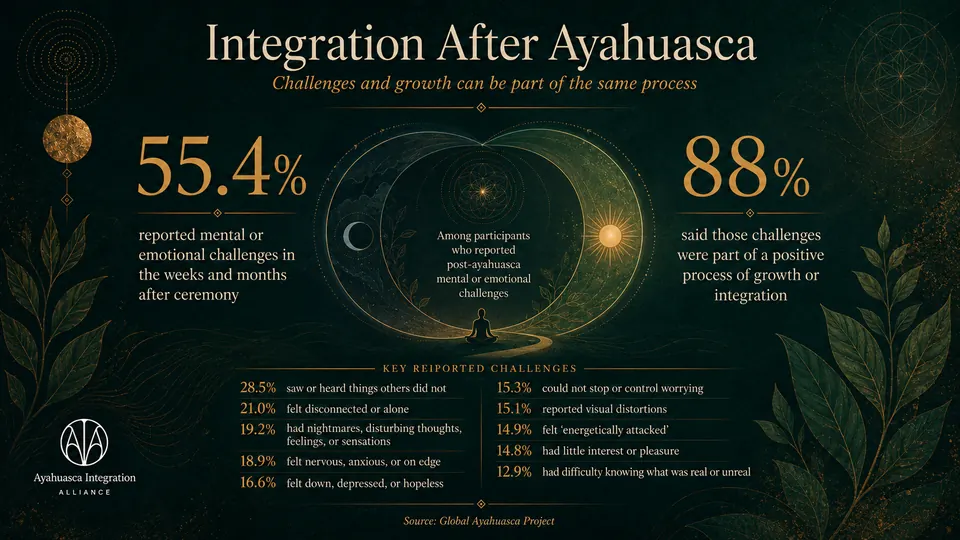
The most frequently reported effects were:
- Seeing or hearing things other people did not: 28.5%.
- Feeling disconnected or alone: 21%.
- Nightmares or disturbing thoughts, feelings or sensations: 19.2%.
- Reduced interest or pleasure: 14.8%.
- Difficulty knowing what was real and what was not: 12.9%.
This requires careful interpretation. Some participants who reported visions or perceptual changes explicitly said they did not regard them as negative. The category contains experiences ranging from spiritually meaningful perception to genuine psychological difficulty.
Severity and duration also matter. For seven of the ten measured effects, most people who experienced them said they lasted less than one week. The highest rate recorded for any specific effect at the study's most severe level was 4.4%, for visual distortions.
Among respondents reporting these effects and answering the relevant questions:
- 11.9% sought support from a psychiatrist, physician, therapist, counselor or alternative health practitioner.
- 76.3% believed the effects were completely part of a positive process of growth or integration.
- 11.3% believed they were somewhat part of such a process.
- Combined, 87.6%, or approximately 88%, connected them at least partly with positive growth or integration.
- 3.9% said they were not part of a positive process.
- 8.6% were unsure.
The cleanest way to say this is:
More than half reported some form of increased difficulty afterward. Yet 88% of those reporting these effects understood them as completely or partly connected to positive growth or integration.
This does not mean that suffering automatically equals healing. It means that many respondents later interpreted a difficult period as meaningful within a larger developmental process.
Meaning and safety are not identical. A person may eventually grow through an experience that was also destabilizing, frightening or poorly supported. Calling an experience “integration” does not remove the need to take anxiety, depression, isolation, impaired reality testing or persistent perceptual changes seriously.
Chapter X
Why improvement and difficulty can coexist
At first, the findings can look contradictory.
How can 70% of respondents with anxiety report major improvement while 55.4% of a broader sample report some form of increased mental, emotional or perceptual effect afterward?
Because the studies are measuring different things in different groups.
One study asked people with existing anxiety or depression to evaluate the overall effect ayahuasca had on those conditions. Another asked whether respondents had ever experienced an increase in any of ten specific effects during the following weeks or months.
A person could report that their long-term anxiety improved while also passing through nightmares, loneliness, emotional volatility or a temporary period of intensified anxiety. Another person could value their spiritual experience while simultaneously needing professional support. A third could deteriorate and find no positive meaning in it at all.
Human change does not move in a clean line from illness to wellness. Ayahuasca can disrupt the strategies through which a person has maintained psychological order. If those strategies were restrictive, their disruption may eventually create freedom. If they were holding a vulnerable psyche together, destabilizing them may create significant risk.
The adverse-effects study found that a history of anxiety, physical health conditions and stronger acute spiritual experiences were associated with greater odds of reporting subsequent mental-health effects. Spiritual intensity was not only associated with positive outcomes. It was also associated with difficulty.
That may be one of the most important findings in the entire field.
The depth of an experience does not guarantee that the person has the internal or external capacity to metabolize it. A powerful opening can exceed the structure available to hold it.
Chapter XI
Mystical experience does not predict everything
A smaller prospective study followed 53 people who had never previously consumed ayahuasca. In that sample, 55.6% met the study's threshold for a “complete mystical experience.”
One month later, the researchers found significant increases in spirituality alongside improvements in several measures of mental health, self-connection, personality and relationship satisfaction. Formal religious practice did not increase.
However, the measured dimensions of mystical experience had little predictive power for most outcomes in this study. Baseline characteristics, including negative emotionality, body dissociation and self-efficacy, were more useful predictors of change.
This disrupts another easy story: that the most mystical experience must produce the greatest healing.
Sometimes an experience of God, unity or ego dissolution becomes a turning point. Sometimes it becomes an extraordinary memory without sufficient behavioral consequence. Sometimes the most therapeutically relevant moment is not a cosmic vision but a precise recognition of fear, self-abandonment, grief or responsibility.
Mystical intensity and integration capacity are different variables.
Chapter XII
Encounters with entities and changes in belief
A 2025 study examined 415 ayahuasca users who reported an entity encounter. Participants described their religious identity before and after the encounter.
Among men, atheist identification fell from 19.9% to approximately 7%. Among women, it fell from 7.9% to approximately 3%. Agnostic identification declined to around 11% to 12% in both groups, while religious belief increased. The increase was statistically significant among men but not among women.
This study is relevant because it examines a specific kind of ayahuasca experience: meeting what appears to be an autonomous being or intelligence.
It cannot tell us how common entity encounters are among all ayahuasca users because the sample was selected for having had one. It also cannot determine whether the beings exist independently of the person experiencing them.
What it does show is that such encounters can have enduring consequences for belief. When an atheist experiences communication with something perceived as conscious, intelligent and separate from the self, the experience may challenge the structure through which they previously defined reality.
The person may interpret the encounter as God, a spirit, an ancestor, an aspect of consciousness, an archetype or a construction of the brain. The interpretation may continue evolving for years.
Chapter XIII
Experiences of death and beliefs about consciousness
Ayahuasca can also produce the felt experience of dying or being dead.
In one study of 54 experienced users, 66.7% reported at least one ayahuasca-induced personal-death experience. In a larger second sample, 49.2% of 305 respondents reported one.
These experiences were associated with:
- A stronger sense of having transcended death.
- Greater certainty that consciousness continues after bodily death.
- Increased environmental concern.
- Greater reported ability to cope with distressing life problems.
- A stronger sense of fulfillment through living according to personal values.
These were cross-sectional associations in samples of experienced users. They do not prove that ayahuasca removes death anxiety, that consciousness survives death or that a personal-death experience will improve someone's life.
They do demonstrate that the experience can reorganize a person's relationship with mortality. A person who no longer understands death in the same way may also stop organizing life around the same fears.
That change can be liberating. It can also become ungrounded if the person uses a spiritual interpretation to deny the reality of the body, ordinary consequences or the value of being alive.
Chapter XIV
Long-term users appear different, but selection remains a problem
A longitudinal study compared 127 long-term ritual ayahuasca users with 115 participants active in religions that did not use ayahuasca.
The ayahuasca users scored higher on self-transcendence, spiritual orientation, purpose in life and psychological wellbeing. They scored lower across the study's measures of psychopathology and did not show evidence of cognitive impairment. These differences were still present at the one-year follow-up.
This does not prove that long-term ayahuasca use created those differences.
People who experience serious negative consequences may stop using ayahuasca and disappear from long-term user samples. People drawn to ritual ayahuasca communities may already differ in personality, spirituality, lifestyle and social support. The researchers explicitly identified this survivor and self-selection problem.
Long-term studies can tell us that sustained ritual use is not inevitably associated with psychological or cognitive deterioration in the groups studied. They cannot tell us that frequent use is safe or beneficial for every person.
Chapter XV
Does ayahuasca reveal spiritual reality?
Science can establish several things with reasonable confidence:
- Ayahuasca can generate experiences that people interpret as encounters with God, spirits, ancestors, plant intelligence or ultimate reality.
- These experiences are frequently rated as deeply meaningful and spiritually significant.
- They can be followed by lasting changes in spiritual identity, beliefs about death, connection with nature, personal values and behavior.
- Stronger spiritual experiences are associated with some positive outcomes.
- Stronger spiritual experiences are also associated with a greater likelihood of some difficult mental-health effects.
Science cannot presently establish:
- That a perceived spirit or ancestor existed independently of the experiencer.
- That information received during an altered state is automatically accurate.
- That mystical certainty is equivalent to factual certainty.
- That becoming more spiritual necessarily makes someone healthier, kinder or more responsible.
- That a difficult aftermath is always evidence that healing is taking place.
The responsible position is not forced belief or forced disbelief.
To dismiss every spiritual encounter as meaningless hallucination exceeds what the evidence can establish. To accept every vision as literal truth also exceeds the evidence.
The experience must be allowed to remain powerful without becoming unquestionable.
Chapter XVI
A changed belief system still requires discernment
Ayahuasca may loosen religious conditioning, atheistic certainty or a worldview built entirely around what can be physically measured. That opening can be profound.
It can also create a new form of dogma.
A person may stop obeying one authority and begin obeying visions. They may leave one rigid belief system and replace it with another populated by spirits, signs, cosmic assignments and absolute interpretations. They may begin treating the intensity of an experience as proof of its accuracy.
The research does not justify that move.
What the research supports is more demanding: ayahuasca can alter belief, but changed belief still requires examination.
If an experience tells you that you are specially chosen, does that belief make you more accountable or less? If you believe you met an ancestor, what happens in your relationship with your living family? If you experienced unconditional love, can you embody that love when another person disappoints you? If you encountered the interconnection of all life, does it change how you consume, work, speak and repair harm?
The value of a spiritual experience is not measured only by how sacred it felt. It is also measured by the life that forms around it.
Epilogue
The science is compelling, but it cannot make the decision for you
The evidence now supports a serious conclusion: ayahuasca is capable of producing enduring psychological, spiritual and behavioral change.
For many people in these studies, the reported movement was toward reduced anxiety or depression, greater spirituality, stronger connection with nature, meaningful insight and significant life change. For others, the aftermath involved fear, isolation, disturbed perception, worsening symptoms or the need for professional support. For some, both were true.
These numbers should never be used to sell ayahuasca.
Seventy percent reporting major anxiety improvement is not a promise that your anxiety will improve. An 81% rate of spiritual identification is not a reason to pursue an experience you do not feel called toward. The fact that 88% later found growth in difficult effects does not mean that every destabilizing experience is secretly beneficial.
Science gives us perspective. It shows the scale, the possibilities, the patterns and the risks. It does not replace personal discernment.
Ayahuasca may change what you believe about yourself and reality. The more important question is whether you have the honesty, support and space to live responsibly with what it opens.
Research & sources
The evidence behind this article
Every percentage and finding above is drawn from the following peer-reviewed sources. Where a number is retrospective self-report, we say so. Where a controlled trial exists, we cite it separately.
- Global Ayahuasca Project research index. Lists the project's peer-reviewed publications and the different analyses produced from the survey. Global Ayahuasca Project, Project Reports
- Spiritual identity, insights and life changes. Source for the 8,907-person analysis, the 6,360-person religious and spiritual identity subsample, the increase from 51% to 81% identifying as spiritual, insight frequencies, and reported life changes. Perkins et al. (2023), Psychoactives, 2(4), 256–286
- Spiritual significance, plant intelligence, true self and proposed mechanisms. Synthesizes Global Ayahuasca Project findings concerning spiritual significance, sacredness, nature connection, plant intelligence and the source of insights. Perkins et al. (2023), Frontiers in Neuroscience, 16, 879221
- Anxiety and depression outcomes. Source for the Global Ayahuasca Project's 11,912-person survey description, the anxiety subgroup of 1,125, the depression subgroup of 1,571, reported improvement and worsening rates, and study limitations. Sarris et al. (2021), Journal of Affective Disorders Reports, 4, 100098
- Mental, emotional and perceptual effects after ayahuasca. Source for the 7,839-person mental-health analysis, the 55.4% reporting at least one effect, specific effect frequencies, duration, support-seeking, and the 87.6% connecting these effects with growth or integration. Bouso et al. (2022), PLOS Global Public Health, 2(11), e0000438
- First-time users, mystical experience and spirituality. Source for the prospective study of 53 ayahuasca-naïve participants, the 55.6% complete mystical-experience rate, increased spirituality without increased religious practice, and measured one-month changes. Perkins et al. (2022), Frontiers in Pharmacology, 13, 884703
- First-time users and six-month mental-health follow-up. Source for the 40-person prospective study, the 45% baseline psychiatric diagnosis rate, and the persistence of reported clinical improvements at six months. Jiménez-Garrido et al. (2020), Scientific Reports, 10, 4075
- Randomized trial in treatment-resistant depression. Source for the 29-patient trial, seven-day response and remission findings, and comparison with placebo. Palhano-Fontes et al. (2019), Psychological Medicine, 49(4), 655–663
- Entity encounters and religious belief. Source for the 415-person selected sample and reported changes in atheist, agnostic and religious identification after an ayahuasca entity encounter. Xin, Griffiths & Davis (2025), Journal of Psychoactive Drugs
- Personal-death experiences. Source for the 54-person and 305-person samples and associations with beliefs about death, consciousness, environmental concern, coping and life fulfillment. David et al. (2023), Frontiers in Psychiatry, 14, 1287961
- Long-term ritual users. Source for the comparison of 127 long-term ayahuasca users and 115 religious controls, including spirituality, psychopathology, cognition and the authors' warning about self-selection. Bouso et al. (2012), PLOS ONE, 7(8), e42421
Written by David Vox, founder of the Ayahuasca Integration Alliance. Last reviewed July 24, 2026.